NewDelhi: The Government of India has already set in motion the process to conduct the caste census after a delay of over 5 years. However, the census is not the main issue troubling the opposition. It’s the delimitation that will follow the census. Notably, the Modi government passed the Women’s Reservation Act 2023, officially known as the Nari Shakti Vandan Adhiniyam (NSVA) (106th Constitutional Amendment Act), in September 2023. It mandates a 33% reservation for women in the Lok Sabha and state/UT assemblies. However, since there were concern among the opposition parties, the government has reportedly proposed that if not 2026 census, then the delimitation could be done on the basis of 2011 census, as done during the UPA government.
According to an Indian Express report, the proposal includes increasing the Lok Sabha seats to 816, from 543 at present and then reserving 273 seats for women as per the NSVA Act. Notably, Union Home Minister Amit Shah has reportedly chaired a meeting with leaders of BJD, YSRCP, NCP (SP), Shiv Sena (UBT) and AIMIM on the issue and is likely to meet Congress, TMC, DMK and SP leaders in the coming days.
Since there is a possibility of the Census continuing beyond the 2029 General elections, the government is trying to form a consensus on the 2011 census data. Notably, this is likely to address the fear of southern states, which has opposed increasoing seats as per the population.
Notably, the concern of a proportionate increase in seats have been looming for long and the Southern states have alleged unfairness as they succeeded in population control compared to northern states.
In 2021, Congress MP Manish Tewari had raised the issue and at that time, the increase was expected by 2024.
“I am reliably informed by Parliamentary colleagues in the BJP that there is a proposal to increase the strength of Lok Sabha to 1000 or more before 2024.
He said that job of MPs is to make laws for the country and the role was emasculated by the 10th schedule of the Indian Constitution. “To take care of development imperatives, we have 73rd and 74th Constitutional Amendment topped by legislative assemblies. If the proposal is to increase LS to 1000 is true, it has implications…Do not yet know whether the proposal/idea includes 1/3rd Reservation for women. Good move but why 1/3rd out of 1000 or more why not 543 that Hon’ble CP Smt Sonia Gandhi has been fighting for over two decades. Women are 50 per cent but Parliament of 1000 has its own implications,” Tewari had said.
Karnataka Congress MP Karti P Chidambaram had also expressed similar concerns. “Public debate is needed. A large country like ours needs more directly elected representatives. But if the increase is based on population it will further diminish the representation of the southern states, that will not be acceptable,” said Chidambaram.
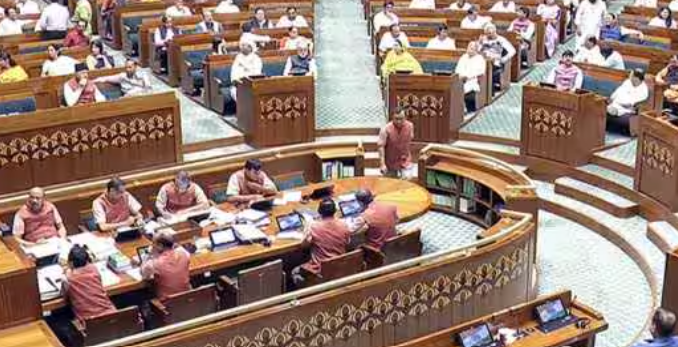
Notably, at that point in time, the new Parliament was under construction. The new Parliament has a seating capacity of around 1000 Lok Sabha MPs. It is expected that if the 2026 census is taken as the base for delimitation, the seats in the Lok Sabha could go up to 1,000. There is a rule to have an MP for every 10 lakh voters. In the 2019 Lok Sabha polls, there were around 88 crore voters and if the voter base is considered for delimitation, then there should be at least 888 MPs, instead of 543.
Bureau Report
Leave a Reply