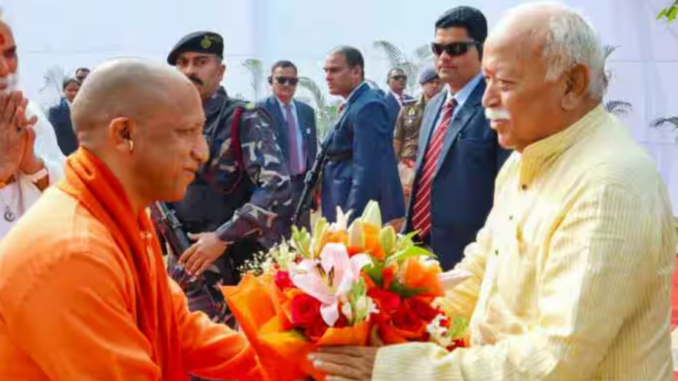
Lucknow: In Uttar Pradesh, even a courtesy meeting carries a message. So when a chief minister starts travelling city to city for closed-door sessions with the ideological parent of his own party, the political world takes note. Over the past several weeks, Yogi Adityanath has been doing exactly that. He has held coordination meetings with Rashtriya Swayamsevak Sangh functionaries in Ghaziabad, Kanpur, and Agra, following earlier sessions in Lucknow, Gorakhpur, and Varanasi. The frequency alone has raised eyebrows. The timing, with assembly elections due in 2027, has raised them further.
The backdrop to all of this is the BJP’s bruising performance in the 2024 general election. The party won just 33 of Uttar Pradesh’s 80 Lok Sabha seats, down sharply from 62 in 2019. For a party that treats UP as the cornerstone of its national strategy, the result demanded an honest reckoning.
The wound that won’t quite close
What made it sting more was the contrast with 2022, when the BJP and its allies swept the state assembly elections with 273 of 403 seats. The ground had evidently shifted in two years, and party insiders know it.
The reassessment that followed pointed to familiar problems — weakening booth-level mobilisation, fraying ties between elected leaders and grassroots workers, and a growing disconnect between the government machinery and the party’s organisational network. The Sangh, with its deep cadre presence across the state, became the natural place to begin repairs.
When Bhagwat came to Lucknow
The most politically loaded of these recent interactions took place on 18-19 February, when RSS chief Mohan Bhagwat visited Lucknow. Officially, the visit was part of the Sangh’s centenary year outreach. In practice, it carried unmistakably political undertones.
On the first day, Adityanath and Bhagwat met privately for around half an hour at a school in the city. The chief minister reportedly briefed the RSS chief on his government’s work, infrastructure, industrial investment, law and order, and welfare delivery. The following day, Bhagwat met the two deputy chief ministers, Keshav Prasad Maurya and Brajesh Pathak, separately.
The sequencing of those meetings was not lost on observers.
The man watching from the wings
Maurya has been a quietly significant figure in UP politics for years. When the BJP swept to power in 2017, he was among those considered for chief minister before the party’s central leadership settled on Adityanath. Since then, tensions within the state unit have never fully disappeared.
They surfaced again after the 2024 Lok Sabha result. In July that year, Maurya remarked publicly that the party is bigger than the government, a pointed observation that was widely read as a comment on how Adityanath runs the administration. Around the same time, he skipped several cabinet meetings before appearing at a public event in August to praise the chief minister. The mixed signals were noted.
Bhagwat’s separate meeting with Maurya during the Lucknow visit was, in that context, more than a formality.
Pathak’s interaction carried its own subtext. Earlier that same day, he had hosted a ceremony at his residence honouring 101 Batuk Brahmins. In a state where caste arithmetic shapes everything from Cabinet formation to booth management, the gesture was read as part of the BJP’s broader effort to shore up support among the Brahmin community.
What the Sangh is actually saying
The groundwork for the current round of engagement was laid last November, when RSS functionaries held closed-door meetings with ministers, senior bureaucrats and BJP leaders in Lucknow. The conversations reportedly focused on everyday governance complaints, the kind that travel upward from the grassroots but rarely reach the top in time. Shortly after, Bhagwat met Adityanath at the Sangh’s office in Ayodhya, a meeting that lasted nearly an hour.
According to those involved in these sessions, Sangh representatives have been candid. They have flagged concerns about the responsiveness of local BJP leaders and pushed for ministers and MLAs to engage more directly with workers on the ground. Corruption complaints and farmers’ grievances have also been raised. The goal, as some describe it, is a tighter three-way coordination between the government, the BJP organisation and the Sangh itself.
The ideological layer
Running alongside the political repair work is a sharper ideological message. During his Lucknow address, Bhagwat spoke at length about caste discrimination, calling practices such as untouchability irrelevant in modern society. His remarks were part of the Sangh’s ongoing Panch Parivartan campaign, which focuses on social cohesion, family values, environmental responsibility and economic self-reliance.
The emphasis on Hindu unity is not accidental. The Samajwadi Party and other opposition groups have been building social coalitions of backward classes, Dalits and minorities with renewed energy since 2024. The Sangh’s counter-narrative, that caste division weakens rather than strengthens, is partly a political response to that mobilisation.
Adityanath, for his part, has been increasingly open about his own roots in the organisation. At a public event last November, he spoke of his association with the Sangh since his younger days and described Bhagwat as a karmayogi, a term that signals both personal regard and ideological alignment.
The long road to 2027
In the BJP’s history, these kinds of structured engagements between the Sangh and state governments have often been a prelude to serious electoral preparation. The current round of meetings appears to be the opening chapter of that exercise for Uttar Pradesh.
The state sends the largest number of members to Parliament. Losing ground here has national consequences. With two years still to go before the assembly polls, the BJP has time, but not unlimited time, to rebuild what 2024 exposed.
Bureau Report
Leave a Reply