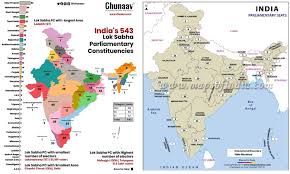
India is heading toward a major political reset. And this time, it’s not about elections—it’s about numbers that could make or break any party’s path to power. Right now, the Lok Sabha has 543 elected members. But that number may not stay the same for long. With delimitation expected after 2026, discussions are already heating up. Some estimates suggest the total seats could rise to around 816, if the 2011 census is taken as a base for delimitation. Others go even further, projecting a House of nearly 1,000 members if population is fully factored in, because, as per the rule, there should be on MP for each 10 lakh population.
At present, the leaders of the Southern states allege that northern states often decide the party in power as they have more seats. The five southern states and the islands account for a total of 131 Lok Sabha seats, while the northern states have around 204 Lok Sabha seats. Then the middle belt of Gujarat, Maharashtra and Madhya Pradesh account for 103 seats. These states are capable of sending any party to power at the Centre, even without the support of the southern states.
The upcoming delimitation, to be followed by the caste census, has sparked a fear in the southern states as they fear under-representation. Earlier, it was decided that the delimitation will be on the basis of the 2026 census. However, amid opposition from rival parties, the ruling NDA is now pushing to take the 2011 census as a base for delimitation. If that happens, the Lok Sabha seats may rise to 816, with 273 seats for women as per the Naari Shakti Vandan Adhiniyam or women’s reservation quota rule. Even under this, the proportionate increase in seats as per population will see a higher increase in the north compared to the south, say experts.
This is where the anxiety begins—especially in southern India.
What exactly is delimitation?
In simple terms, delimitation redraws constituency boundaries and reallocates seats based on population. It’s meant to ensure fair representation. But here’s the catch. Population growth hasn’t been uniform across India.
Northern states like Bihar and Uttar Pradesh have seen a sharp increase in population. Southern states like Tamil Nadu, Kerala, and Karnataka have grown much more slowly—largely due to better family planning and social indicators, analysts say.
So, compare this. After delimitation, the Lok Sabha seats in Uttar Pradesh can go as high as 143 from the current 80, while those in Tamil Nadu may increase to 49 from the current 39.
Why the South feels uneasy
According to political experts, delimitation sounds fair on paper but in reality, it could shift political power.
If seats are redistributed strictly by population, northern states stand to gain more MPs. Southern states, despite better governance indicators, could see their share shrink or grow much slower, they say.
There’s already data backing this fear. Estimates suggest states in the north could see massive jumps in seats, while southern states may see only modest increases—or even a relative decline in influence.
That’s why many southern leaders call it a “penalty for success.” They argue: we controlled the population, and now we lose representation?
The 1000 vs 816 debate
So where do these numbers come from?
If India strictly follows population-based representation, the Lok Sabha could theoretically expand to around 1,000 or more seats. But that creates logistical and political challenges.
A more “manageable” proposal being discussed is around 816 seats. Even this smaller expansion changes the balance of power significantly.
More seats overall don’t automatically mean fairer distribution. It depends on how those seats are divided across states—and that’s exactly the core concern.
The new Parliament building factor
Interestingly, India has already prepared for a bigger House. The new Parliament building, inaugurated in 2023, has a Lok Sabha chamber that can seat up to 888 members. It can even accommodate 1,272 members during joint sessions.
This isn’t accidental. The expanded capacity clearly signals that an increase in MPs is expected in the future. But infrastructure is the easy part. Political balance is harder.
If the northern states gets larger share after delimitation, which is likely due to high population, they will have greater influence compared to the present, feel analysts. This shapes the power corridors in Delhi and decides who gets heard more.
There’s also a deeper concern. India’s diversity works because different regions feel equally represented. Any perception of imbalance could strain that trust.
The freeze on seat redistribution—based on the 1971 Census—ends in 2026.
After that, a new delimitation exercise becomes inevitable. The real question is not whether seats will increase. It’s how India balances population, fairness, and federalism.
Bureau Report
Leave a Reply