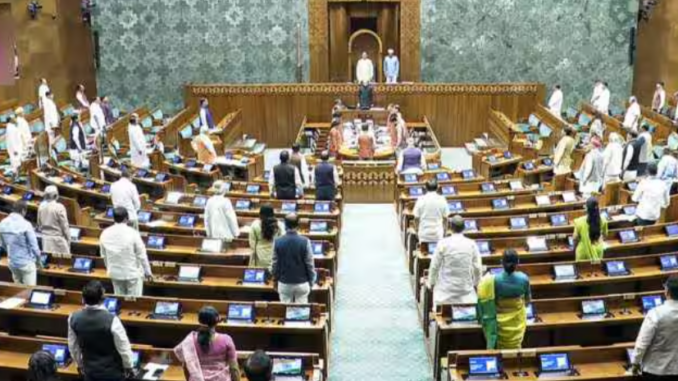
New Delhi: The Parliament of India began its special session today, April 16, in New Delhi, which is being regarded as an important turning point in Indian democracy. The purpose of today’s special parliamentary session is threefold: to review three bills to get women’s reservation, Nari Shakti Vandan Adhiniyam 2023, implemented and to completely redefine the legislative map of India. As a result of this, the maximum strength of the Lok Sabha will likely grow from 543 to 850 total members.
Due to the serious nature of the legislation discussed in parliament today, the House has allotted an incredible 18-hour timeframe for general debate on the issues. If these bills implement the proposed changes, they could entirely redefine political representation for the next several decades.
The legislative bills: Increasing the number of members of the House, providing reserved seats
The Indian government has brought forward three specific legislative proposals to resolve the issue of women’s reservation that have been stalled for years as a result of having to wait for the census to be finished and then the subsequent delimitation to take into account those counts.
The Constitution (131st Amendment) Bill 2026: This is the main bill and proposes to raise the current Lok Sabha size limit from 543 total members to 850 total members, comprised of 815 members from the states and 35 members from the Union Territories.
The Delimitation Bill 2026: Will provide the framework for redrawing constituency limits utilising the most recent available population data. This bill will also facilitate the removal of the previous freeze placed on the delimitation of every constituency in India for the first time since 1971.
The UT Laws (Amendment) Bill, 2026: This provides that the 33% reservation for women will extend to the legislative assemblies of Union Territories having legislatures and will include the Union Territories of Delhi, Jammu & Kashmir, and Puducherry.
A new dawn in women’s political life
Even though the Women’s Reservation Act passed in 2023, these new bills are, as stated, “the gears that make it go” and will enable over 270 women to be elected in the 2029 General Elections to the Lok Sabha.
The draft bill also stipulates a “rotational system,” whereby reserved seats for women will be rotated among different constituencies and states and UTs. Thus, it will provide greater diversity in representation over time.
Opposition—’A power grab’ versus a federal balance
The political controversy resulting from these proposed changes continues to rage across this country. Rahul Gandhi (Congress) stated that they oppose all forms of women’s reservation unconditionally; however, this proposal is a “cloak” for arbitrary delimitation!
“This is a power takeover through back-door approaches via manipulation of electoral boundaries!” stated Gandhi, further stating that no caste census means this move ignores OBC, Dalit, and tribal people.
The new coalition formed on Wednesday, called the “INDIA” coalition, is made up of several parties, including the SP, DMK, and JMM, to form a unified alliance against these bills.
FAQs on Lok Sabha delimitation 2026
The process of delimitation involves redrawing boundaries for Lok Sabha and State Assembly constituencies so that each district has similar populations according to the principle of “one person, one vote, one value.”
Here are some important points about Delimitation:
Constitutional basis: Delimitation is regulated by Articles 82 and 170 of the Constitution, which require a revision of all districts after every census.
The Commission: The delimitation process is overseen by an independent high-power delimitation commission appointed by the president.
Composition: A retired Supreme Court justice is in charge of the commission, which also includes the chief election commissioner and the state election commissioners.
Authority: The orders issued by the Commission have the force of law and cannot be appealed in court.
The freeze of 1976: To prevent punishment to states that implemented effective family planning, the total number of parliamentary and legislative assembly seats was frozen at their level as determined by the 1971 census. This moratorium will continue until the year 2026.
Looking ahead: Delimitation has only been conducted four times, and it is expected that after the 2026 census, populations will be updated based on data collected after that date (i.e., through the 2021 census).
Women’s reservation connection: The 2023 Women’s Reservation Bill is expected to be implemented fafter the next delimitation process is completed
Bureau Report
Leave a Reply