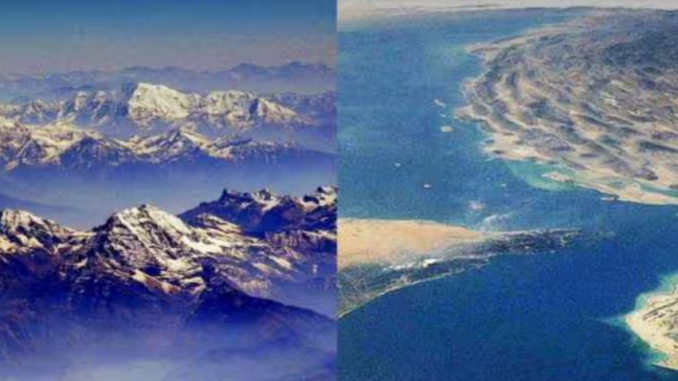
New Delhi: The Strait of Hormuz, world’s one of the busiest maritime routes, has been in the centre of debate because of disruption that is affecting international energy supply. The pressure in this narrow waterway has highlighted its strategic importance. What is less known is that this sea route shares a geological connection with the Himalayas, despite being thousands of kilometres apart.
Both regions trace their origin to the ancient Tethys Sea, which once existed between two massive landmasses on earth. Over millions of years, tectonic movements transformed this vast ocean into what we see today as a narrow strait in the west and the world’s highest mountain range in the east.
The ancient world before modern continents
Around 250 million years ago, earth looked different from today. Instead of separate continents, there were two large landmasses known as Laurasia in the north and Gondwana in the south. Between them lay the Tethys Sea, a vast ocean that stretched across a large part of the planet and separated these landmasses.
Over time, tectonic plates beneath the earth’s surface began to move. The Arabian Plate started pushing northwards towards the Eurasian Plate, gradually changing the shape of the ocean.
How the Strait of Hormuz was formed
As the Arabian Plate moved north, the western part of the Tethys Sea slowly began to shrink. This process eventually led to the formation of the Strait of Hormuz, a narrow passage that connects the Persian Gulf with the Arabian Sea.
The same tectonic collision also led to the formation of the Zagros mountain range in present-day Iran. Over millions of years, the remaining part of the sea in this region was compressed into a narrow channel, leaving behind what is now one of the most important maritime oil routes in the world.
The birth of the Himalayas
Far to the east, a similar geological process took place. Around 50 to 40 million years ago, the Indian Plate collided with the Eurasian Plate. Since both were continental plates, neither was forced beneath the other. Instead, the land crumpled and folded upward.
This collision trapped sediments from the sea between the two plates. Layers of mud, limestone and marine fossils were pushed upward over millions of years, eventually forming the Himalayan mountain range.
Even today, marine fossils can be found at the top of Mount Everest, showing that these peaks were once part of an ancient seabed.
A shared geological origin
The Tethys Sea did not disappear in a single event. It gradually closed in different regions as tectonic plates continued to move. In the west, the movement of the Arabian Plate formed the Strait of Hormuz. In the east, the collision of the Indian Plate created the Himalayas.
Both regions are therefore different outcomes of the same ancient ocean. One became a narrow but important sea passage for international energy trade, while the other rose into the highest mountain range on earth.
In places such as Wadi Al-Hitan in Egypt, around 100 kilometres south of Cairo, fossil is of more than 400 marine species have been found. These fossils date back to the period when the Tethys Sea was slowly disappearing, offering direct evidence of this ancient oceanic world.
The geological history of these regions continues to influence present-day realities. The Strait of Hormuz is a critical point in international energy movement, while the Himalayas stand as a reminder of how powerful tectonic forces can transform oceans into mountains over time.
Bureau Report
Leave a Reply