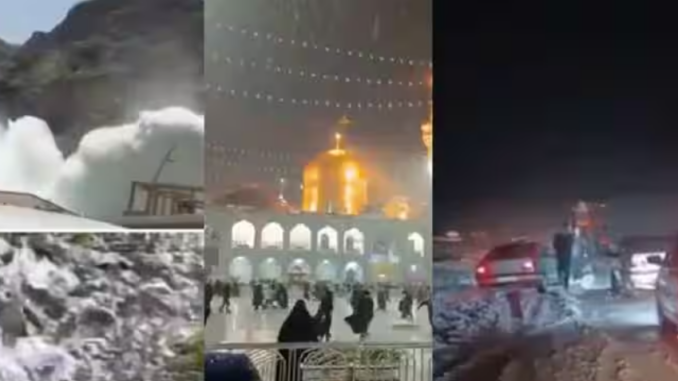
Iran: Many pro-Iran social media handles are sharing videos of sudden weather change in Iran as the country witnesses massive rains, snow and drop in temperature. The Iranian handles are claiming that the weather change has happened because Iran has destroyed American radars and Israeli weather-engineering machines that used to manipulate the country’s weather. Notably, Iran has been parched by continuous drought for over a decade. The empty reservoirs and cracked lake beds were enought to tell the water crisis story. However, after a war of around 50 days, the weather appears to have turned favourable.
As heavy rains, unexpected snow, and decrease in temperatures blows new life into vegetation and dams fill up to 100% of their capacity, the Iranian social media is abuzz with conspiracy theories. Pro-Iranian handles are circulating videos of overflowing dams and snowy roads, claiming this sudden shift is the direct result of Iran destroying American and Israeli ‘weather-engineering machines’ in the recent war.
Theory: Radars, Strikes, and Sudden Rain
The social media users claim that Iran struck advanced US radar installations and Israeli weather machines during the recent conflict. They claim that while the Iran targeted high-tech systems—including the THAAD missile defense and a $1.1 billion AN/FPS-132 early warning radar in Qatar, the strike perhaps also disabled a regional network of weather manipulation.
According to these claims, these installations weren’t just for defense; they were allegedly being used to “steal” clouds, diverting Mediterranean moisture away from Iran and toward neighboring rivals. Proponents of this theory point to the timing: the radars were hit, and almost immediately, the “drought” ended.
What is ‘Rain Stealing’?
The concept of “cloud theft” isn’t new in Iranian political discourse. It’s a narrative that has bubbled up periodically since at least 2018. At its core, the accusation suggests that foreign powers—specifically the U.S., Israel, and the UAE—use geoengineering to manipulate atmospheric patterns so that rain clouds release their moisture before they ever reach Iranian airspace.
High-ranking officials have previously pointed to satellite imagery showing thick snow cover on the mountains of Turkey and Afghanistan, while the Iranian side of the same border remained brown and dry. To many, this visual contrast was “proof” of an invisible wall built by technology.
From Conspiracy to Conventional Conflict
Science-Fiction: While the idea of ‘weather machines’ sounds like science fiction, it often serves to mask more grounded, albeit complex, regional disputes. The Middle East is currently home to very real water wars, but they are fought with concrete and policy rather than ‘weather lasers’.
Dam Politics: The Tigris-Euphrates river system has seen massive dam construction in Turkey (the GAP project) and Iran. Tehran alleges that these dams hold back water from flowing downstream into Iraq and Iran. The shortage of water thus leads to depleted reservoirs in Iran.
Cloud Seeding: To fulfill the lack of water and mitigate the water crisis, countries like Iran and the UAE use cloud seeding to boost rainfall. While this can enhance a local storm, meteorologists agree it cannot “steal” a weather system or create a decade-long drought across an entire nation.
Why rain is back in Iran? Science explained
While hardline Iranian supporters believe in the weather manipulation conspiracy theory, the allegations have been rejected by Iran’s own Meteorological organization. They have categorically pushed back against the rain ‘theft’ claims. The Iranian weather scientists claim that the atmospheric phenomenons are too vast for human machines to control.
The weather scientists say that the heavy rains were due for long after years of El Nino/La Nina cycles and extreme heat. Therefore, the shift in weather coincided with military conflict, and provided a perfect vacuum for the conspiracy theorists.
Whether the result of high-tech sabotage or simply a generous turn in the seasonal cycle, the overflowing dams in Iran and Iraq are a welcome sight. However, as the water levels rise, the debate over who—or what—really controls the clouds is unlikely to evaporate anytime soon.
Bureau Report
Leave a Reply