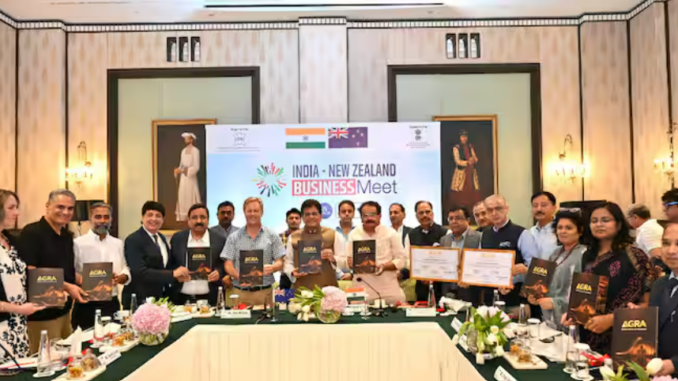
NewZealand: India and New Zealand signed a historic Free Trade Agreement (FTA) on Monday, under which tariffs will be eliminated on 100% of India’s exports to New Zealand, while tariffs on 95% of India’s imports from New Zealand will either be sharply reduced or completely removed.
The agreement was sealed in the presence of Commerce Minister Piyush Goyal and his New Zealand counterpart Todd McClay.
The FTA, which was concluded in a record nine months since negotiations were launched on March 16, 2025, marks a new chapter in the economic relations between India and New Zealand. The agreement will provide India with immediate duty-free access to 100 per cent of tariff lines.
This is a significant improvement from the current situation, where New Zealand levies a 10 per cent tariff on approximately 450 tariff lines of Indian exports, including textiles and apparel, leather and headgear, ceramics, carpets, and automobiles and auto components.
During the signing ceremony at the India-New Zealand Business Forum in Delhi, Union Minister Piyush Goel said, “This partnership between New Zealand and India is not only reflected in the businesses that we do together, but the Indian soldiers fought shoulder to shoulder with the Australian and New Zealand soldiers at the Battle of Gallipoli, reflecting the shared commitment to preserving democracy, preserving independence, preserving what is right for the world.”
He further mentioned leverages under the India-New Zealand FTA saying, “Today, as we sign the free trade agreement between the two countries, we are expanding that partnership to open the doors for greater business, larger investments, more trust and confidence in each other, and working towards ensuring that the people of New Zealand and the people of India can work together in the years to come… I think when we map the entire arc of this partnership, from farm to factory, from factory to a prosperous future for both nations. It clearly shows us the immense possibilities between our two countries and the effort that we now all need to move from discussions to deliverables,” quotes.
What does the India-New Zealand FTA offers
- 100% duty-free access for all Indian exports to New Zealand from day one, covering every tariff line.
- Elimination or sharp reduction of tariffs on 95% of India’s imports from New Zealand.
- Immediate removal of New Zealand’s existing 10% tariff on approximately 450 tariff lines of Indian exports, benefiting key sectors such as:
- Textiles and apparel
- Leather and headgear
- Ceramics and carpets
- Automobiles and auto components
- Strong boost to India’s leather and footwear industry with tariff reduction from 5% to zero, with potential to grow the sector to $50 billion by 2030. Agra, which produces 75% of India’s leather footwear, is positioned as a global sourcing hub.
- Protecting sensitive sectors: India successfully protected its domestic industry by keeping all dairy products (milk, cream, whey, yoghurt, cheese, etc.) and several farm products outside the FTA.
- Additionally, New Zealand commits to facilitating $20 billion in investment into India over the next 15 years.
- Quota of 5,000 visas for skilled Indian professionals, allowing stays of up to 3 years in sectors of interest to India, including:
- AYUSH practitioners, yoga instructors, chefs, and music teachers
- IT, engineering, healthcare, education, and construction
- Working Holiday Visa programme: 1,000 young Indians per year, with multiple entries for a 12-month stay.
- First-ever annex on student mobility and post-study work visas with New Zealand:
- Indian students are allowed to work up to 20 hours per week during studies.
- Extended post-study work visa.
- Pharmaceuticals and Medical Devices: Faster regulatory approvals through acceptance of GMP and GCP inspection reports from comparable international regulators, reducing compliance burdens and speeding up market access.
- Health and Traditional Medicine: A dedicated provision that formally recognises AYUSH systems.
Bureau Report
Leave a Reply