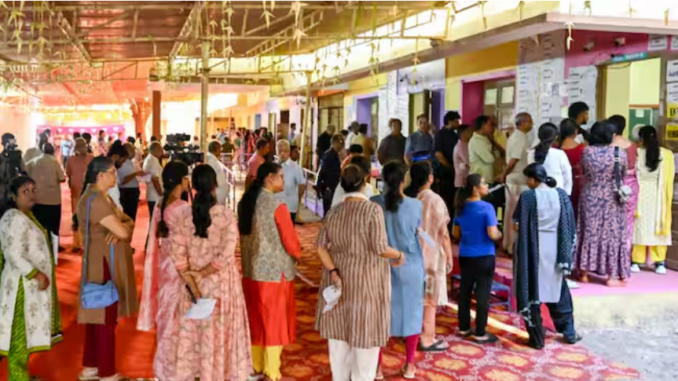
TamilNadu: Tamil Nadu has rarely been easy to read, but the assembly election of 2026 has made prediction particularly difficult. With votes already cast on April 23 and counting scheduled for May 4, the state is sitting on a result that nobody, despite the confident claims coming from every camp, can say with any certainty they have sewn up. The reason is straightforward. What has traditionally been a straight fight between the DMK and the AIADMK has this time become a four-way contest, with actor Vijay’s Tamilaga Vettri Kazhagam and Seeman’s Naam Tamilar Katchi both claiming a meaningful share of the political space.
That fragmentation has made the arithmetic considerably harder to work out.
The wider election picture
Tamil Nadu is one of five regions going to the count on May 4. The Election Commission announced elections for Tamil Nadu, Kerala, Assam, West Bengal and the Union Territory of Puducherry on March 15. Polling in Kerala, Assam and Puducherry was completed on April 9. West Bengal voted for 152 constituencies in the first phase on April 23, the same day as Tamil Nadu, with a second phase covering 142 seats scheduled for April 29. All results will be declared simultaneously on May 4.
What each side is arguing
The ruling DMK, which is seeking a second consecutive term, is drawing comfort from the divided opposition. Party leaders believe that the entry of TVK into the contest, combined with NTK’s consistent vote base, will carve up the anti-incumbency vote and prevent it from consolidating behind any single challenger, an outcome that would work squarely in the ruling alliance’s favour. It is a calculation the DMK has seen pay off before.
The AIADMK-led front is making the opposite argument. Its leaders point to the voter turnout, estimated at over 84 per cent, as evidence of a silent wave of discontent running beneath the surface, drawing comparisons with the mood in 2011 when the then-incumbent government was voted out decisively. High turnout, in their reading, spells trouble for whoever is in power.
Vijay’s TVK has positioned itself as something altogether different, a disruptor unburdened by the baggage of the established Dravidian parties. The party has campaigned on the promise of political change and argues that a significant section of voters has grown tired of the DMK-AIADMK duopoly that has defined Tamil Nadu politics for decades. Whether that fatigue translates into seats is the central question hanging over May 4.
NTK, meanwhile, is not chasing government. Its support base is ideologically committed and built around Tamil nationalist politics. It will not win power, but it will take votes, and in a close contest, those votes matter enormously to everyone else.
Political observers watching the state closely are cautious about reading too much into any single indicator. The fragmented nature of the contest means that vote splits could produce outcomes that defy the broader trend in any given region. Regional variations within Tamil Nadu add another layer of complexity.
What is not in doubt is the stakes. The result on May 4 will not just determine who governs Tamil Nadu for the next five years. It will signal where the state’s politics are heading, whether the two-party Dravidian order holds, whether a new force has genuinely arrived, or whether the old guard has simply found a new way to survive.
Bureau Report
Leave a Reply