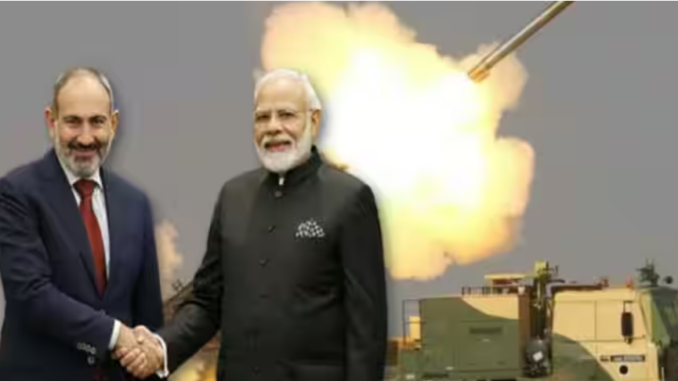
NewDelhi/Armenia: A major realignment is emerging in the South Caucasus region as Armenia moves away from long-standing dependence on Russian weapons and increasingly turns to India and France for defence supplies. Once almost entirely reliant on Moscow, Yerevan is now witnessing a clear reorientation in its military partnerships, changing the regional balance that has been unchanged for decades.
A decade ago, Armenia sourced nearly 90 percent of its weapons from Russia. That dominance has declined over time, with Moscow’s share now falling to below 10 percent. In its place, India and France have strengthened their defence cooperation with Yerevan.
France has strengthened its defence ties with Armenia, while French President Emmanuel Macron has pointed to stronger strategic engagement with Yerevan. At the same time, India has emerged as Armenia’s second-largest arms supplier after France. In fact, Yerevan is now New Delhi’s largest weapons importer.
This change is not happening in isolation. Armenia has been strengthening its links with European and trans-Atlantic defence structures while reducing reliance on Moscow. Between May 4 and 6, Yerevan hosted the 8th European Political Community (EPC) summit, aimed at strengthening cooperation with European nations. The move pointed to Armenia’s growing intent to align with Europe.
India’s expanding defence footprint in Armenia
Armenian forces have acquired from India systems such as the Pinaka Multi-Barrel Rocket Launcher, Akash-1S Surface-to-Air Missile System, ATAGS 155mm Towed Howitzer, Swathi weapon-locating radars and MArG truck-mounted artillery systems.
Reports suggest that Armenia is also exploring additional procurement, including Akash-NG systems and Astra Mk2 air-to-air missiles. Negotiations are also underway on upgrading its Su-30 fleet to Indian Su-30MKI standards.
A further agreement worth around $2.5-3 billion is being finalised for the possible acquisition of Sukhoi Su-30MKI fighter jets. If completed, it would become one of the largest defence deals between the two countries.
Indian-made systems are now becoming core to Armenia’s artillery, air defence and counter-battery capabilities. Since 2022, the country has reportedly purchased more than $2 billion worth of defence equipment from India alone. One major order worth $720 million for 15 systems has begun delivery. There are also reports suggesting that Armenia has gained access to India’s Pralay surface-to-surface missile system.
Russia’s shrinking role in Armenia’s defence structure
Armenia was once seen as a close Russian partner in the South Caucasus, even hosting Moscow’s military presence and acting as an important logistical link for Moscow in the region. However, recent years have seen a decline in trust between the two sides.
After repeated conflicts with Azerbaijan, Armenia’s reliance on Russian weapons has weakened. Having lost wars twice in the last six to seven years, Yerevan has increasingly questioned the effectiveness of Russian systems.
Today, Russia’s role has been reduced to a fraction of what it once was, while India and France have filled the gap with faster deliveries and broader defence cooperation.
A shift toward Europe
Armenia’s increasing engagement with Europe is also visible in its political outreach. The country has expressed interest in closer ties with the European Union, although full membership is distant.
Macron has even suggested that Armenia should consider the withdrawal of nearly 5,000 Russian troops stationed in the country, arguing that Moscow has not been able to secure its interests effectively. He has also suggested that European institutions should take a greater role in Armenia’s security structure.
A changing strategic map in the Caucasus
The combined rise of India and France in Armenia’s defence structure represents a major change in regional geopolitics. A country that once functioned within Russia’s strategic orbit is now building a diversified defence network with European and Indian partners.
With Russia’s influence declining and new suppliers stepping in, Armenia’s military partnerships are no longer anchored to Moscow. They are instead moving toward a multi-partner structure that shows changes in Eurasian security dynamics.
Leave a Reply