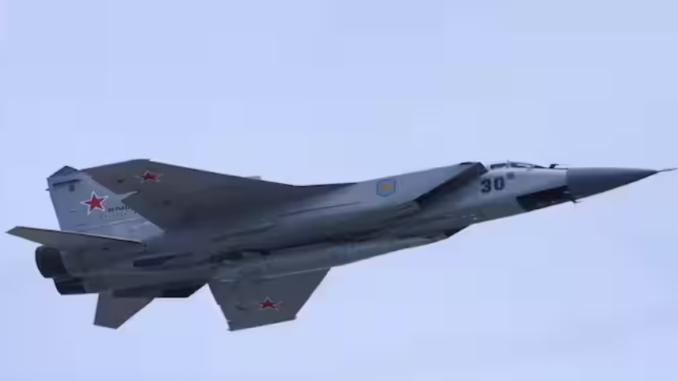
NewDelhi: The MiG-31 has often been described as one of the most powerful interceptors built during the Cold War era. In the ongoing Russia-Ukraine war, this aircraft has again stood out for its long-range strike capability and its role in launching some of Moscow’s most advanced weapons, including hypersonic missiles.
In the military confrontation between the two countries, MiG-31 fighter jets have been used along with the long-range R-37M air-to-air missile. Reports have claimed that these jets have taken down Ukrainian aircraft from long distances, largely because Ukrainian fighters do not match their speed, altitude or range.
Also known as Axehead in NATO classification, the R-37M missile has been built to target high-value assets such as tanker aircraft, AWACS platforms and other command and control systems. According to a report in the Royal United Services Institute (RUSI), around October 2022, Ukraine’s air force faced nearly six R-37M missile launches every day.
Russia has also deployed MiG-31 jets in Crimea, and Ukraine reportedly attempted drone strikes on the Belbek airbase to target them on the ground.
On 26 January, Ukrainian Air Force sources reported that Russia launched 55 missiles, 24 Iranian-origin Shahed drones and one Kh-47 Kinzhal hypersonic missile in a coordinated strike. The Kinzhal missile, which is also launched from the MiG-31 platform, has no confirmed interception record from Ukraine’s side.
What makes MiG-31 different
According to retired Air Marshal Anil Chopra, MiG-31 was developed by the Mikoyan design bureau to replace the MiG-25 in the Soviet era. It is a high-speed interceptor built for long-range operations rather than modern multirole combat.
The upgraded MiG-31BM version is claimed to be more capable than earlier variants. Its Zaslon-M radar can detect large airborne targets, including AWACS-class aircraft, at distances of up to 400 kilometres. It can track up to 24 targets at once and engage eight simultaneously.
The aircraft is also integrated with the R-37 missile family, which can reach speeds of Mach 6 and has a range of up to 400 kilometres. A group of four MiG-31 aircraft can share data through a network link, allowing control over a wide operational front of nearly 900 kilometres.
An aircraft India tested but did not choose
Air Marshal Chopra, who has flown the MiG-31 himself, described his experience during a test flight in 1999 at the Sokol Aircraft Plant in Russia. He flew along with Russian pilot Alexander Georgievich Konovalov.
He said that the aircraft accelerated rapidly during takeoff. At one point, it reached an altitude of 15 kilometres and a top speed of Mach 2.7. He described the experience as smooth even at supersonic speeds, adding that the aircraft could have gone faster under test conditions.
Why India did not buy the MiG-31
Russia had offered the MiG-31 to India and attempted to convince both the government and the Indian Air Force (IAF) to consider it. The aircraft’s main attraction was its ability to launch long-range missiles and even anti-satellite weapons.
However, concerns over maintenance complexity, ageing design and limited multi-role flexibility played a role in India’s decision. The aircraft was primarily built for high-altitude interception rather than versatile combat operations.
India was moving towards the Sukhoi Su-30MKI platform, which offered better adaptability for multiple roles. At the same time, the country’s experience with earlier Russian aircraft such as the MiG-25 had shown operational limitations in long-term maintenance.
The IAF also had interest in strengthening its fleet around platforms that could integrate better with systems such as AWACS operations and long-range missile capabilities. However, instead of adopting MiG-31 for such roles, the country turned to developing its own systems, including ground-based anti-satellite capability.
Budget constraints also mattered. Inducting a small number of MiG-31 aircraft would have created logistical complexity without improving operational efficiency.
A platform that still defines a category
Even today, MiG-31 is one of the fastest operational combat aircraft and continues to be used in specialised roles by Russia and Kazakhstan. Its relevance in modern warfare is not only about the aircraft, but also the weapons it carries and the long-range interception concept it represents.
The aircraft’s story also shows how air forces choose platforms based not only on capability, but on long-term strategy, integration and sustainability in modern combat systems.
Leave a Reply