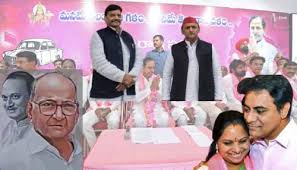
When Telangana was carved out of Andhra Pradesh in 2014, K. Chandrashekar Rao (KCR) led his Telangana Rashtra Samiti (TRS), now renamed Bharat Rashtra Samithi (BRS), to a sweeping victory. His daughter K. Kavitha entered Parliament from Nizamabad, quickly becoming the party’s voice in New Delhi, while his son K.T. Rama Rao (KTR) was positioned as heir-apparent back home. For a while, the family’s arrangement looked seamless: Kavitha represented national outreach, KTR managed state politics, and KCR presided as patriarch.
That balance was disrupted in 2019 when Kavitha lost her Lok Sabha seat. KCR rehabilitated her through the Legislative Council, but the setback exposed cracks. Matters worsened dramatically in 2023 when her name surfaced in the Delhi liquor scam. Kavitha was arrested in March 2024 and spent months in Tihar Jail before being released in August. Though KTR visited her occasionally, Kavitha felt the party offered little real support when she needed it most.
Kaleshwaram Probe Rekindles Tensions
The Congress government’s decision to call for a CBI probe into alleged irregularities in the ambitious Kaleshwaram Lift Irrigation Project has only deepened the turmoil. Kavitha openly accused her cousins — senior leader T. Harish Rao and ex-MP J. Santosh Kumar — of conspiring against her father. Both, however, remain trusted lieutenants of KCR and KTR, raising the question: are Kavitha’s charges about betrayal, or about the larger battle over inheritance and political clout?
When Family Feuds Eclipse Party Politics
Kavitha’s suspension from the BRS and her resignation as MLC highlight a broader truth about regional satraps: when leadership revolves around families, internal rifts can destabilise the entire party. Once power is secured, disagreements over tickets, posts, and resources often replace ideology as the primary fault lines.
This is hardly unique to Telangana. In Uttar Pradesh, the rift between Akhilesh Yadav and his uncle Shivpal Yadav in 2017 hurt the Samajwadi Party’s electoral prospects, despite both belonging to the same ideological tradition. Maharashtra’s Shiv Sena, once tightly held together by Bal Thackeray’s charisma, split into two rival factions under Uddhav Thackeray and Eknath Shinde — a fight less about ideology and more about control of the organisation and its symbol. Bihar’s RJD, too, has seen Lalu Prasad Yadav’s elder son Tej Pratap marginalised while Tejashwi consolidates the reins of power, with their sisters strategically placed in elections. Sharad Pawar-led NCP also got split into two parts with his newphew Ajit Pawar leading a rebellion to join the NDA government.
The Bigger Picture
Kavitha’s ouster is therefore not just a family drama or a Telangana-specific crisis. It underlines a structural weakness of many regional parties: they are often built around strong personalities but weak institutions. Without mechanisms to manage succession or distribute opportunities fairly, personal rivalries quickly morph into political earthquakes.
For the Congress, this feud is a chance to spotlight corruption charges and the dysfunction inside BRS. For the BJP, it feeds the narrative of dynastic decay. But for the BRS itself, the real danger is erosion from within. KCR may still command loyalty, and KTR may still hold the party machinery, but the spectacle of a daughter publicly blaming cousins while being cast aside by her father shows how family feuds can overshadow even the most formidable political machines.
Can Family-Led Parties Avoid Implosion?
If regional outfits want to escape this cycle of infighting, they must invest in building institutions stronger than individuals. Establishing clear rules for succession, empowering second-rung leaders, and decentralising decisions on tickets and funds can prevent disputes from becoming personal. Internal democracy — even in a limited form through consultative bodies — can make family-led parties more resilient. Without such reforms, every generational shift risks turning into a public feud, weakening not just the party but the regional balance of power itself.
Bureau Report
Leave a Reply