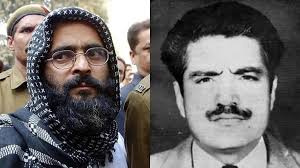
The Delhi High Court on Wednesday raised concerns over the absence of supporting evidence in a petition seeking the removal of the graves of Parliament attack convict Afzal Guru and JKLF founder Maqbool Bhat from Tihar Jail, prompting the petitioner to withdraw the plea with permission to refile it with proper data.
A Division Bench comprising Chief Justice Devendra Kumar Upadhyaya and Justice Tushar Rao Gedela was hearing the Public Interest Litigation (PIL) filed by Vishwa Vedic Sanatan Sangh, represented by Advocate Barun Sinha.
Radical Pilgrimage Site For Extremist Groups
The petition argued that the burial sites near Jail No. 3 had turned Tihar into a “radical pilgrimage” site for extremist groups, which allegedly violated the Delhi Prisons Rules, 2018, and the Delhi Municipal Corporation Act.
The Bench pressed the petitioner to present concrete evidence. Chief Justice Upadhyaya remarked, “You claim that people are visiting and paying respects, but what is the data? Can a grave that has existed for 12 years now be challenged?” The court also noted that the government had decided to bury the convicts inside the prison after execution to avoid any law-and-order problems.
Following these observations, Advocate Sinha requested to withdraw the petition with liberty to refile it with supporting documentation. The court allowed this and dismissed the case as withdrawn.
The petition, filed under Article 226 of the Constitution, had sought urgent judicial intervention to remove the graves of Mohammad Afzal Guru and Mohammad Maqbool Bhat, which are currently located within the premises of Central Jail, Tihar, Delhi.
The petition claimed that constructing and maintaining these graves inside a state-controlled prison was unlawful, unconstitutional, and against public interest. It argued that this arrangement violated the Delhi Prisons Rules, 2018, which mandate that the bodies of executed prisoners be handled in a way that prevents glorification, ensures prison discipline, and maintains public order.
The plea further stated that the graves had effectively turned Tihar Jail into a site of extremist veneration, where radical elements allegedly gather to honor convicted terrorists. The petitioners contended that this poses a threat to national security, public order, and the secular principles of the Constitution.
Consequently, the petition requested that the Court direct authorities to relocate the graves to a secure, undisclosed location, following the precedent set in the cases of executed terrorists like Ajmal Kasab and Yakub Memon, where measures were taken to prevent glorification.
Bureau Report
Leave a Reply