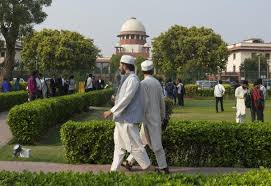
New Delhi: The Supreme Court, on Monday, has put on hold several contentious provisions of the Waqf (Amendment) Act, 2025, which had sparked nationwide protests, particularly from Muslim organisations. The court raised serious concerns over clauses that could lead to an “arbitrary” exercise of power and breach the principle of separation of powers.
A bench comprising Chief Justice of India DY Chandrachud, Justice BR Gavai, and Justice AG Masih observed that while there was no sufficient ground to stay the entire Act, certain sections “need protection”.
“The Collector cannot be permitted to adjudicate the rights of personal citizens, and this will violate the separation of powers,” the court stated, adding, “Till adjudication happens by the tribunal, no third-party rights can be created against any party. The provision dealing with such powers to the Collector shall remain stayed.”
The paused clause had empowered District Collectors to act as the final authority in disputes over Waqf property ownership. Protesters had warned that this could result in a rise in illegitimate claims over Waqf lands, bypassing judicial scrutiny.
Another contentious provision, requiring a person to have practised Islam for at least five years in order to declare a Waqf, was also stayed. Chief Justice Gavai remarked, “Without any mechanism, it will lead to the exercise of arbitrary power.”
The bench further directed that Waqf Boards must not include more than three non-Muslim members, and the Central Waqf Council should have no more than four non-Muslim representatives, echoing concerns around the religious character and administrative integrity of such bodies.
Despite the partial stay, the court reaffirmed its general approach towards legislation, “Our presumption is always in favour of the constitutionality of a statute,” it noted, adding that judicial intervention is warranted only in the “rarest of rare cases.”
The matter has been widely watched due to its legal and religious implications, and the Supreme Court’s intervention is seen as a significant step in balancing state authority with citizens’ rights.
On May 22, the apex court heard the petitioners’ and the Centre’s views over three hearings before reserving its order on issuing a stay on the Waqf (Amendment) Act, 2025 — a law vehemently defended by the Union government as a tool to curb misuse of Waqf properties and ensure greater transparency in their management.
The validity of the contentious Act, which came into effect on April 5 with the Presidential assent, has been challenged by, among others, All India Majlis-e-Ittehadul Muslimeen (AIMIM) MP Asaduddin Owaisi and Congress MP Mohammad Jawed.
The petitioners moved the apex court, contending that the amendment amounted to discrimination against Muslims.
The new law amended the Waqf Act, 1995, to address the regulation of Waqf properties, that is, religious endowments or properties dedicated exclusively for religious or charitable purposes under Islamic law.
On April 17, a Bench headed by then CJI Sanjiv Khanna decided not to order a stay on the Waqf (Amendment) Act, 2025, after the Centre assured the apex court that certain provisions would not be implemented for the time being.
Bureau Report
Leave a Reply