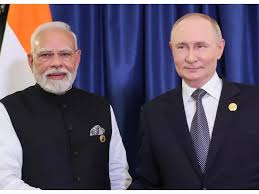
NewDelhi: The 23rd India-Russia Annual Summit is underway today between Prime Minister Narendra Modi and President Vladimir Putin, against the backdrop of high expectations within the global defence industry. Besides the diplomatic engagements, the summit is also likely to ink a few multi-billion dollar defence deals on fighter jets, missiles, and state-of-the-art air defence systems.
Announcements about a deal for the Russian Su-57 fifth-generation fighter jet and the S-500 anti-hypersonic missile system have wide attention for their potential to reshape the military balance in South Asia. India is pressing ahead with its long-standing defence partnership despite ongoing pressure from the United States.
Background: Summit Under Stress – A Partnership
President Putin arrived in Delhi on December 4th, his first visit to India in four years. An unscheduled personal reception at the airport by PM Modi underlined the strong and durable character of the bilateral relationship, which essentially is built around defence, energy, and trade.
Russian dominance: Russia, in 2024, remained India’s largest arms supplier. The Stockholm International Peace Research Institute estimated that Russia accounted for 36% of India’s weapon imports.
Success of S-400: Russian technology proved its effectiveness when the S-400 neutralized a reported 95% of Pakistani drones during ‘Operation Sindoor.’
Kremlin Confirmation: In confirmation, Kremlin spokesperson Dmitry Peskov identified that the talks would involve more supplies of the S-400 system, besides prospective contracts for the advanced Su-57 and S-500. The Defence Secretary Rajesh Kumar Singh said that the summit will only deepen the long-standing partnership.
High-Stakes Deals Expected to be Finalized
Large companies in the defence sector, such as Hindustan Aeronautics Limited, Bharat Dynamics Limited, and Bharat Electronics Limited, would benefit from the summit’s results.
1. Su-57 Fighter Jets: India’s Fifth-Generation Ambition
The Su-57 is a Russian stealth fighter jet counterpart to the U.S. F-35. India is reportedly seeking at least two squadrons totaling about 84 jets as an option to make up the shortfall of fighter jets in the IAF.
Technology Transfer: Full 100% technology transfer is being offered by Russia, enabling joint production in India, with production likely at HAL Nasik, a major push for the ‘Make in India’ initiative.
Cost & Value: At an estimated cost of about $300 million per jet, the overall deal could be valued at $74 billion in total, a much-needed “stop-gap” for India’s indigenous Advanced Medium Combat Aircraft project.
2. S-500 Missile Defence System: Hypersonic Shield
The S-500 ‘Prometheus’, the successor to the S-400, is designed against hypersonic missiles, ballistic missiles, cruise missiles, and even satellites in low Earth orbit.
Range & Scope: With a 600-kilometer range, the system is tipped to be a game-changer for India’s air defence capabilities.
Negotiation Details: India is looking at a $5.4 billion deal, asking for nearly 60% technology transfer. Joint production with Russia’s Almaz-Antey company is in discussion and would benefit companies like BEL.
3. Other Major Upgrades and Deliveries
Besides the two flagship deals, discussions on several other key programs are expected to be concluded:
S-400: Discussions on the remaining deliveries, plus a $3 billion deal for 280 additional missiles.
BrahMos Missile: Plans to extend the range to 800 kilometers and launch the next-generation BrahMos-NG.
Su-30MKI Overhaul: A $7.4 billion upgrade and overhaul program for 100 existing Su-30MKIs, in partnership with HAL.
Naval & Ground Assets: Deliveries on light tanks (Sprut), Pantsir systems, Talwar-class frigates, and the long-awaited Akula-class submarine by 2028.
Strategic And Economic Impact
The results of the summit will have an immediate effect on the stock market and regional geopolitics.
Stock Market Boost: Stocks of defence companies like HAL, BDL, Mazagon Dock, and L&T have already gained. According to experts, the sector may see 20-30% growth if the deals for Su-57 and S-500 are sealed.
Strategic Autonomy: The deals mark the seriousness of India’s commitment to self-reliance in defence-also known as Atmanirbhar Bharat-and its defiance of U.S. pressure on the CAATSA sanctions issue, upholding its independent foreign policy.
Non-Defence Talks: The leaders will also discuss linking India’s RuPay and Russia’s Mir payment systems and ensuring a stable supply of affordable oil and energy.
Bureau Report
Leave a Reply