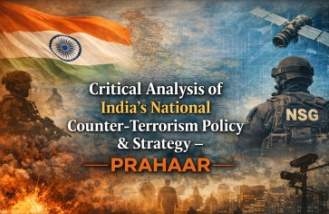
India has long battled with cross-border terror networks breaching its borders. The November 10, 2025, blast near Red Fort and the April 2025 Pahalgam attack remain fresh scars, signalling towards terror’s hybrid evolution, yet India’s response, from surgical strikes to Operation Sindoor, declares unequivocally: “Any act of terror will be considered an act of war.”
Recent intelligence busts expose Pakistan-linked modules, now compounded by rising Bangladesh connections and Khalistani extremism. Last week’s arrests in Tamil Nadu, Kolkata, and Delhi trace roots to Pakistan with Bangladesh ties, while Khalistanis, ISI-backed, target Punjab. The Red Fort case arrests have reached 11, signalling India’s intolerance towards terrorism.
India’s neighbourhood has never been trustworthy. The changing face of terror has unmasked a “Tri-Terror” axis- with Pakistan as the epicentre, but is the chaos looming, or does India’s new comprehensive national counter-terrorism policy, “PRAHAAR,” hold answers?
Let’s look at a more comprehensive picture of the tri-terror axis and India’s first comprehensive national counter-terrorism policy, ‘PRAHAAR’, with expert analysis.
Pakistan ISI: The Puppet Master
At the heart of this tri-terror threat sits Pakistan’s ISI, the “central nexus” connecting Khalistani extremists, militants in Kashmir and Bangladesh radicals.
What started as the “K2” strategy, coordinating Kashmir and Khalistan, has expanded, with ISI now training terrorists and smuggling drugs, arms, and ammunition via drones across the Punjab-Rajasthan international border, bypassing the fortified Line of Control.
“Pakistan ISI is the one that is linked between Khalistani, Kashmir, as well as the one that is coming through Bangladesh,” says Maj General AK Siwach, YSM, VSM and Bar, Former Head of Territorial Army.
Kashmir Fades, Punjab Rises
Jammu & Kashmir militancy is in its “last stage”, said Maj Gen AK Siwach, with just 50-60 terrorists remaining, 80% foreigners, with Lashkar-e-Taiba and Jaish-e-Mohammed leadership “completely wiped out” and morale crushed by ammunition shortages. As infiltration plummets, ISI pivots to Punjab, arming “overgrown workers” as sleeper cells.
“Punjab is now becoming the next terror target… We have to be slightly more alert,” warned Maj Gen Siwach. While Former Indian Ambassador Deepak Vohra agrees on the overall network that could be “hexagonal or octagonal”, but India will “smash it before they can even say, ‘hey, what’s happening?’”, Stressing on India’s preparedness and hunt for terrorists with its excellent intelligence network.
Khalistan: A Fading Proxy Dream
Khalistani activists have grown abroad in countries like Canada, the US, UK, and Germany, but are “out of touch with India because they’re living overseas… They have no idea what is going on now in India,” highlighted Deepak Vohra. They’re trying to “piggyback on these other fellows,” propped up solely by ISI support.
Earlier, Canadian journalist Terry Milewski also made similar comments, saying, “The movement has always depended on Pakistani support and would wither instantly without it.” It’s no grassroots fire—it’s a manufactured proxy.
The Khalistan extremism flourished during the reign of Former Canadian PM Justin Turedue but with comming in of Mark Carney, India-Canada relations have seen a major switch. PM Mark Carney has distanced himself from Khalistani sympathisers, restored diplomatic ties with New Delhi, and focused on trade and is currently visiting India, easing tensions and weakening the proxy.
Bangladesh: Double Trouble Post-Hasina
Former Bangladesh PM Sheikh Hasina’s 15-year rule kept Northeast India peaceful by dismantling ULFA, NSCN, and PLA camps in Chittagong Hill Tracts.
Her ouster and asylum changed the scenario “Activities of terrorists have increased manifold… ISI footprints have increased tremendously,” said Maj Gen Siwach.
Risks include camp revivals, 12 lakh Rohingyas in Cox’s Bazar trained by ISI for infiltration, rising anti-India sentiment, and minority persecution, fueled by Bangladesh-Pakistan military ties, argued AK Siwach.
Yet Former Diplomat Deepak Vohra pushes back, calling Bangladesh’s leaning towards Pakistan as ‘nonsense’, arguing that Bengalis remain “a Bengali first, reffering to newly sworn-in Bangladesh PM Tarique Rahman.
“He is very proud of his culture,” haunted by 1971 atrocities; radicals like Jamaat-e-Islami are just “fringe idiots” or “lunatics,” said Former IFS Vohra.
PRAHAAR: India’s Game-Changing Shield
The Union Home Ministry on 23rd February laid out “PRAHAAR,” New Delhi’s new “force multiplier.”
Experts call it India’s Red Corridor” takedown, the policy marks the nation’s first holistic counter-terrorism strategy, revolutionising responses to hybrid threats via seamless intelligence fusion, unified legal mechanisms, and international partnerships, while calling for stronger cyber defences, narco-terror countermeasures, and robust deterrence tools.
The policy emerges amid escalating threats like state-sponsored cross-border terror, hybrid warfare tactics, encrypted digital channels, drone-enabled smuggling, and the deadly fusion of organised crime with extremist ideologies, and fits aptly with the emerging ‘tri-terror’ network.
The core seven pillars of PRAHAAR:
- Prevention: Safeguard Indian citizens and interests from terror attacks.
- Responses: Deliver swift, proportionate countermeasures to emerging threats.
- Synergy: Unite internal capacities in a whole-of-government framework.
- Rule of Law: Uphold human rights in all threat mitigation efforts.
- Attenuation: Counter radicalisation and terrorism-enabling conditions.
- Global Alignment: Shape international counter-terrorism collaborations.
- Resilience: Foster whole-of-society recovery and strength.
Experts call it an Intelligence Sync with Real-time vertical and horizontal sharing between NIA, CBI, RAW, and states, “Intelligence must flow… at the earliest,” says Maj Gen Siwach.
PRAHHAR acts as force readiness with zonal units that are “well-equipped, well-trained, highly motivated.”
Highlighting its global outreach, former diplomat Deepak Vohra stated, “We will hit them wherever they are.” “Expect terror attacks to decrease dramatically,” he added.
“It’s a step in the right direction,” added Maj Gen Siwach.
Red Lines and Retaliation
Pakistan—“Jihadistan”—now faces a stark warning: state-sponsored attacks are “an act of war.” After Pahalgam, Operation Sindoor delivered a lesson “they will never forget”, argued Deepak Vohra.
On February 26, the Indian Army’s Western Command hinted at ‘even harsher Sindoor 2.0.’ The message is going across the world… don’t mess with India, argued both Maj Gen Siwach and Former envoy Vohra.
Maj Gen Siwach also pointed out the vulnerability at Nepal’s porous border and southern social media radicalisation with NIA’s round out vigilance, even against China despite trade ties, argued the former envoy.
Under Control: The Expert Verdict
India grapples with “multifarious problems,” but experts see strength. “Our networks, our intelligence systems are so powerful… they don’t have a chance in hell,” said Former Ambassador Deepak Vohra.
“Overall, it looks like we are totally in control… We don’t have to be extra worried,” reassured Maj Gen AK Siwach. With PRAHAAR geared up, the axis tests India’s peace, but resilience prevails.
Bureau Report
Leave a Reply