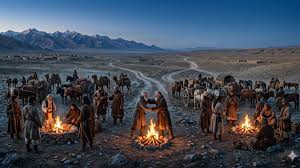
Long before the world witnessed the emergence of the current geopolitical landscape, two groups of people huddled around sacred fires in the freezing environment of the Eurasian steppe. These “brothers” eventually split and went their separate ways. One brother migrated to the Indian subcontinent, while the other brother chose the plateau region of Persia as his home. Today, their legacy is visible in the deep linguistic and spiritual mirrors that reflect the cultures of India and Iran.
The ‘Aryan’ connection: Aryanam and Aryavarta.
The term “Iran” itself is a linguistic evolution of “Aryan.” The ancient term for this region was Aryanam, or Land of the Aryans—a direct cognate for the Sanskrit term Aryavarta.
Linguistic mirrors: Sanskrit and Avestan
The “two brothers” – the Proto-Iranians and the Proto-Indo-Aryans—spoke a language that was so similar that it constituted dialects of the same tongue. The Proto-Iranians gave rise to Avestan—the language of the sacred Zoroastrian scriptures—or Old Persian. The Proto-Indo-Aryan brother gave rise to Sanskrit.
The similarity is stunning. The sacred ritual of fire is referred to as “Yasna” in Zoroastrianism and “Yagna” in Hinduism. This shared reverence for fire constituted the heartbeat of both cultures.
The deep and abiding common heritage of the Persian and Indian civilisations is perhaps best exemplified by the commonalities in their languages and religions. At the heart of the ancient Persian and Indian religions lie the sacred rituals of the Yasna and Yagna, respectively. Both terms refer to the sacred ritual of fire. Both cultures also have the common tradition of partaking of a sacred ritualistic drink. This ritualistic drink is called Haoma by the Persians and Soma by the Indians. Both the Persian and Indian cultures also have the common tradition of tracing the origins of their religions back to the land of the seven rivers. This land is referred to as Hapta Hendu in the Persian text of the Avesta and Sapta Sindhu in the Indian text of the Vedas. Both the Persian and Indian cultures also have the common tradition of revering the wind god as Vayu.
The great inversion: When gods became demons
Perhaps the most intriguing aspect of the common heritage of the Persian and Indian cultures is the “theological split” that led to the development of the two religions. In the Persian religion of the Avesta, the term “Ahura” (lord/divine) represented the highest form of goodness. In the Indian text of the Vedas, the term Asura eventually came to represent the term for demons. In the Persian text of the Avesta, the term “Daeva” represents evil spirits. In the Indian text of the Vedas, the term Deva represents the shining god. Experts have suggested that this could have been the result of an ancient religious or social split in the land of Central Asia.
The fire that never went out
Yet, despite the Islamic conquest of Persia in the 7th century AD, as well as the Mongol invasions that destroyed close to 75% of the Persian people, the connection to their ancient ‘Aryan’ heritage has never been broken.
When the Zoroastrians, called the Parsis, were persecuted in the 8th century, they came to India, the land of the “Vedic brothers.” From this movement, the modern-day Parsis were born, contributing greatly to the industrialisation and military history of India, including the Tata, Godrej, and Field Marshal Sam Manekshaw dynasties.
Shared science: From hospitals to chess
The union of these two cultures changed the world.
Medicine: The first great hospital in the world, Jundi Shahpur in Persia, was built on the Persian model, using the medical knowledge of the Indians.
Literature: The Panchatantra was translated into Pahlavi, the language of the Persians, becoming the most translated book in the world.
Games: While the world was given chess from India, the Persians gave the world backgammon, called Takht-e Nard.
Modern Iran’s hidden identity
In modern-day Iran, the pre-Islamic Persian identity remains a source of great pride for the people of Iran, as they still celebrate the Persian New Year, called Nowruz, using the solar calendar, unlike the Hijri calendar used by the Arabs.
The Faravahar, the winged symbol of the Zoroastrians, is proudly sported as a secular symbol of the “Aryan” identity of the Iranians as a symbol of reclaiming the identity of the ancient “Aryan” race.
The verdict: While the “brothers” went separate ways 3,000 years ago, they are still linked by the thread of fire, language, and philosophy, which even the forces of time could not extinguish.
Bureau Report
Leave a Reply