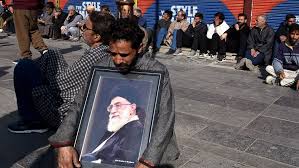
Authorities imposed restrictions across all districts of Kashmir on Monday as a precautionary measure to maintain a peaceful atmosphere following reports of protests over the death of Iran’s leader, Ayatollah Ali Khamenei. Senior police officials within the security grid said the decision was taken to maintain law and order and prevent any untoward incidents amid the prevailing situation.
“It has been decided to impose restrictions as a precautionary measure,” a senior official said. Officials stated that the restrictions were aimed at preventing miscreants and anti-national elements from exploiting public sentiments in the aftermath of the US-Israeli strikes on Iran.
With a sizeable population of Shia Muslims in several areas of Srinagar city, authorities are enforcing stricter restrictions in the old city and uptown areas. All schools, colleges, and universities have been closed for two days. Examinations scheduled for Monday and Tuesday have been postponed by Kashmir University.
Police and security forces, deployed in large numbers, have erected barricades in the city centre, Lal Chowk, where thousands of protesters gathered on Sunday to protest Ayatollah Ali Khamenei’s killing in US-Israeli airstrikes. The main focus remains on Budgam, considered the epicentre of the Shia population, where restrictions have been imposed more heavily.
Restrictions have been enforced across all ten districts of the Valley. The Ladakh administration is also handling the situation cautiously, as the Kargil district in the Union Territory of Ladakh has a predominantly Shia Muslim population.
Vehicular movement between areas has been restricted, while inter-district public transport remained suspended for the day across the Valley.
A massive clash broke out between security personnel and protesters angered by restrictions imposed during a strike and protest call. Mourners pelted stones, while security forces responded with tear gas shells and aerial firing to disperse the crowd. Major clashes were reported in the HMT and Mustafabad areas of Srinagar when mourners were stopped from marching toward the city centre. Smaller incidents of violence were also reported in Nowgam, Batamaloo, and adjoining areas. Traffic on the Srinagar–Baramulla road remained suspended for hours as tensions persisted. Although no casualties or injuries were reported, several security force vehicles and some private vehicles were damaged during the unrest.
The protests erupted after Iranian media confirmed the death of Ayatollah Ali Khamenei, sparking outrage, particularly among Shia communities in Kashmir. Demonstrations were held on March 1 in Srinagar, including Lal Chowk and Saida Kadal, as well as in Budgam, Baramulla, Bandipora, and parts of Ladakh, with protesters carrying portraits of Khamenei and raising anti-US and anti-Israel slogans. In response, the Jammu and Kashmir administration imposed restrictions across the Valley, sealed key areas including Lal Chowk, curtailed mobile internet speeds, and ordered the closure of schools and colleges for two days, postponing examinations. A strike call by Mirwaiz Umar Farooq, supported by Mehbooba Mufti and groups such as the Muttahida Majlis-e-Ulema, further intensified the shutdown, prompting heightened security measures to prevent escalation.
Lieutenant Governor Manoj Sinha chaired a security review meeting on Sunday, while Director General of Police Nalin Prabhat is currently in Srinagar to personally oversee security arrangements and their enforcement on the ground.
In their messages on Sunday, both the Lieutenant Governor and the Chief Minister appealed for calm and urged people to remain peaceful.
The Lt Governor posted on X, “Chaired a meeting to review the security situation across J&K UT. Called upon all communities to stay peaceful and calm. I salute the unwavering and synchronised resolve of our police and security forces in upholding law and order.”
Chief Minister Omar Abdullah reacted by stating, “I’m deeply concerned about the unfolding developments in Iran, including the killing of Iran’s Supreme Leader, Ayatollah Ali Khamenei. I appeal to all communities to remain calm, uphold peace, and avoid any actions that could lead to tension or unrest. We must also ensure that those who are mourning in Jammu and Kashmir are allowed to grieve peacefully. The police and administration should exercise utmost restraint and refrain from using excessive force or unnecessary restrictive measures.”
The Government of Jammu & Kashmir is in close coordination with the Ministry of External Affairs, Government of India, to ensure the safety and well-being of J&K residents, including students, currently in Iran, as thousands of Kashmiri doctors, engineers, and students are presently stranded there.
Bureau Report
Leave a Reply