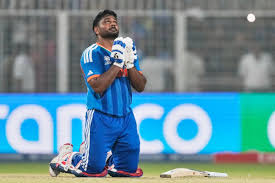
India’s T20 World Cup hero Sanju Samson has found himself at the center of a regulatory debate following his match-winning 97* off 50 balls against the West Indies at Eden Gardens. While the nation celebrates India’s progression to the semi-finals, reports suggest that the ICC is reviewing Samson’s post-match actions for potential violations of the Code of Conduct, leading to anxiety among fans about a possible ban from the upcoming clash against England.
The Celebration in Question
After striking the winning boundary to chase down 196, Samson’s emotions boiled over. The wicketkeeper-batter took off his helmet and threw it to the ground before dropping to his knees in a moment of spiritual gratitude.
The celebration has since gone viral, with social media users labeling it the “true Kerala story.” Fans noted that Samson appeared to offer thanks in a multi-religious manner: opening his arms in an Islamic gesture, making a sign of the cross in a Christian fashion, and finally folding his hands in a Hindu prayer. Addressing the moment with Parthiv Patel on JioHotstar, Samson stated, “I am a great believer, and I want to keep it very private. And, it’s a very special moment for me.”
Understanding the ICC Rules: Will He Be Banned?
The primary concern for the ICC is not the religious expression itself, but the act of throwing the helmet. Under Article 2.2 of the ICC Code of Conduct, players are prohibited from the “abuse of cricket equipment or clothing.” This includes throwing or hitting items such as helmets, bats, or stumps, regardless of whether the intent is anger or excitement.
Potential Penalties:
Level 1 Offence: Most instances of equipment abuse, especially during a celebration rather than a protest, are treated as Level 1 breaches. The maximum penalty is a fine of 50% of the match fee and 1 to 2 demerit points. A match ban is highly uncommon at this level.
Level 2 Offence: A ban generally only occurs if the match referee upgrades the charge to Level 2 or if a player accumulates 4 demerit points within a 24-month period. For instance, Harmanpreet Kaur was famously banned for two matches because her equipment abuse was coupled with public dissent against umpires.
Precedent: Earlier in this tournament (February 18), Scotland’s George Munsey was handed 1 demerit point for throwing his helmet after being dismissed.
ICC Stance on Religious Gestures
The ICC supports positive on-field expressions but mandates that players adhere to the “Spirit of Cricket.” Any gesture that is provocative or insults a religion can be treated as a Level 3 or Level 4 offence under the Anti-Racism Code, which carries heavy suspensions. However, Samson’s inclusive and peaceful moment of gratitude is unlikely to fall into this category, as it did not offend or target any specific group.
Semi-Final Outlook
India is scheduled to face England in the second semi-final on March 5 at the Wankhede Stadium in Mumbai. Samson has already arrived in Mumbai with the squad, and while the match referee has yet to issue an official reprimand, the Indian camp remains hopeful that any penalty will be restricted to a fine or demerit points rather than a suspension.
Given his current form and his leadership in the middle order alongside Suryakumar Yadav, Samson’s absence would be a significant blow to India’s quest for the trophy. No official confirmation of a charge has been released by the ICC at this time.
Bureau Report
Leave a Reply