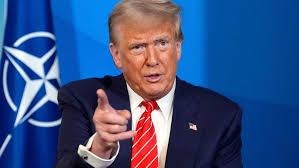
As the joint US-Israeli operation continues into its critical and unprecedented phase, analysts have sounded the alarm about the very real possibility of a conflict escalation that could break the 80-year global taboo. Yet, as the “regime change” desired by the joint “Operation Epic Fury” and “Operation Roaring Lion” continues to stall since the elimination of Supreme Leader Ayatollah Ali Khamenei on February 28, the ascension of Mojtaba Khamenei and the implementation of Iran’s decentralized “Mosaic Strategy” have nullified the conventional Western advantages, sparking rumors of the “Tactical Nuclear Option” in Washington.
The failure of conventional ‘shock and awe’
The US CENTCOM is caught in a mathematical equation they cannot solve. Iran has launched a relentless swarm of low-cost munitions across a 3,000 km front, targeting the economies of the GCC nations comprising Saudi Arabia, the UAE, Qatar, Kuwait, Bahrain, and Oman.
The interceptor trap: An Iranian Shahed-136 drone has a price tag of about $50,000. However, the price of shooting one down with a Patriot missile is about $1 million or more.
Economic attrition: With oil prices soaring above $100 a barrel and the Strait of Hormuz—accounting for 20 percent of the world’s oil exports—functionally closed off, global stagflation threatens to be more deadly than the missiles themselves.
Broken shield: Strategic radar sites in the US are now compromised, leaving the Gulf’s “umbrella” defense riddled with holes.
Why ‘boots on the ground’ is a non-starter
Military experts agree that air power alone has never been effective in regime change. But the alternative is even more terrifying. Iran is three times the size of Iraq and is a natural “mountain fortress.” A ground invasion would “swallow” US divisions and result in a protracted quagmire the US is desperate to avoid.
The 1945 precedent: Hiroshima as a strategic template?
History has shown that when the US military is up against a fanatical enemy ready and willing to fight to the last man despite having lost its navy and air force (as was the case in Japan by August 1945), the US has opted for the “Manhattan” option.
In 1945, the US decided that the loss of life in Hiroshima and Nagasaki was preferable to invading Japan, which would have required a million casualties. Today, in response to President Trump’s demand for “unconditional surrender,” the concept of “Psychological Shock” – using a weapon so shocking that it brings an immediate end to hostilities – is re-emerging.
The rise of ‘tactical’ nuclear weapons (TNWs)
Not ‘strategic’ city-busters, but low-yield tactical warheads.
The hardware: Introduced by the Trump administration’s 2018 Nuclear Posture Review, the W-76-2 warhead is deployed on US Trident submarines.
The yield: 5 to 7 kilotons, or one-third the explosive power of the Hiroshima ‘Little Boy.’
The mission: Unlike traditional ‘strategic’ warheads, TNWs are intended to destroy targeted military assets, such as the deep-enough Fordow enrichment plant, inaccessible to conventional ‘bunker busters’ or MOPs.
The ‘smart munition trap’
According to Pape, the “smart munition trap” is the erroneous assumption that precision conventional bombing will secure victory. If Trump is not seeing results from smart bombs, he may be tempted by the “TNW Trap” – the erroneous assumption that a limited nuclear strike will bring about unconditional surrender without triggering Armageddon.
Potential US nuclear scenarios in Iran:
A signaling blast: A nuclear explosion in an uninhabited area as a show of resolve.
Hard target defeat: Complete destruction of the deep-underground nuclear and command sites.
Shock and awe: Compelling the new regime into an unconditional and immediate surrender.
The ‘off-ramp’ vs. the brink
Former US officials, including former Secretary of State Antony Blinken, are pressing Trump to announce an “Off-Ramp” victory because of the death of Khamenei and the damage done to the Iranian nuclear program.
However, as the threat posed by the 2016 Trump question—”If we have nuclear weapons, why can’t we use them?”—hangs over the Oval Office, the world waits anxiously. A nuclear strike would start an arms race, as non-nuclear countries would be forced to develop nuclear weapons and existing nuclear powers would need to build more.
Bureau Report
Leave a Reply