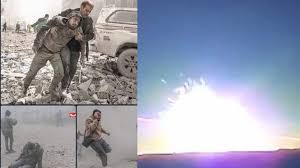
The US-Iran war has entered its fourth day on March 3. The United States and Israel have launched a fresh offensive against Iran while Tehran continues to launch counterstrikes. As per the latest updates, the Israeli Air Force has targeted the Presidential building and government complexes in Tehran and 160 targets in Lebanon.
According to figures released by the Iranian Red Crescent Society, at least 787 people have been killed in Iran since the United States and Israel launched strikes on the country on Saturday. These deaths have occurred across multiple towns and cities as the military campaign has unfolded.
Separately, the US-based Human Rights Activists in Iran (HRANA) reports that 742 civilians have died, including 176 children, as a result of the ongoing attacks — underscoring the toll on non-combatants.
Israel Strikes Iran’s Presidential Office, Lebanon
The Israeli Air Force on Tuesday said that it struck more than 160 targets of the terrorist organisation Hezbollah in southern Lebanon in the last 24 hours. It launched fresh attacks in Tehran and Beirut simultaneously on Tuesday.
“As part of the strikes, Hezbollah terrorists and terrorists from Hezbollah’s “Radwan Force” terrorist organisation were targeted, along with military headquarters of the terrorist organisation Hezbollah that were used to advance numerous terror squads toward the territory of the State of Israel. The targets that were struck were intended to be used by the terrorist organisation to advance and carry out various terror squads against IDF forces and the civilians of the State of Israel,” said the IAF.
It further added that under the precise guidance of Military Intelligence, the Air Force struck overnight at security regime buildings within the leadership compound of the Iranian terror regime in the heart of Tehran.
“In the strike on the compound, numerous munitions were dropped on the Presidential Office and the building of the Supreme National Security Council. In addition, the gathering compound of the regime’s highest forum, responsible for making security decisions, as well as the institution for training Iranian military officers along with other valuable infrastructures, were attacked. The leadership compound of the terror regime is one of the most heavily guarded assets in Iran and spans many streets in the heart of Tehran,” said the IAF.
The Air Force also said that the compound was used by Iranian leaders to manage and run the nuclear program and the advancement of the plan to destroy the State of Israel.
“The compound was attacked following a prolonged process of intelligence gathering and research conducted by Military Intelligence. This is the most important and central headquarters for the Iranian terror regime; its strike deepens the damage to the operational continuity of the regime’s command and control systems,” said the IAF.
Israel also said that it has targeted headquarters, weapons storage facilities, and satellite communication components of the Intelligence Headquarters of the Hezbollah terrorist organisation in the Beirut area, which were used under civilian cover.
“The attacked communication sites served the Hezbollah terrorist organisation as terror infrastructures in which the organisation used to carry out terror activities, intelligence gathering, and also served the organisation for propaganda purposes,” it said.
Iran Responds Fiercely
Iranian forces carried out strikes on military bases in the UAE, Erbil, Bahrain, Qatar, and the Sultanate of Oman, according to official statements. A drone attack reportedly targeted the Fujairah oil field in the United Arab Emirates, while explosions were reported at the port of Ras Al Khaimah in Oman. Tehran described the assault as the fifteenth wave of Operation True Promise 4, carried out under the code name “Ya Fatemeh Al-Zahra (S),” and said it was aimed at US targets in the region. Iran’s Foreign Ministry stated that Tehran remains the only force standing against what it called “evil.” Footage circulated online showed Iran’s Kheibar Shekan missiles being launched toward Israel and US bases on Monday morning and night.
Foreign Minister Seyed Abbas Araghchi said Iran has never initiated a war but will firmly defend its sovereignty. Secretary of the Supreme National Security Council of Iran Ali Larijani feels that, unlike the United States, Iran is prepared for a prolonged conflict and can take on the US and Israel for 60-90 days before mediation begins.
US Deploys B-1 Bombers
According to the US Central Command, the US strike on Iranian missile bases was done using B-1 bombers. While the US has claimed to destroy every Iranian Navy submarine and ship, it has also lost three US F-15 fighter jets in Kuwait.
US Secretary of State Marco Rubio has said that Iran can produce 100 ballistic missiles per month, far outpacing the interceptor production rates of the United States. Rubio claimed Iran had already empowered strike authority to field commanders and pre-positioned missile units, making retaliation ‘automatic’ if attacked.
What Experts Say
Analysts familiar with Iranian security thinking describe a multi-layered missile approach. The strategy allegedly begins with strikes on radar and surveillance systems, followed by waves of relatively inexpensive drones and missiles intended to stretch and deplete air-defence interceptors. More advanced weapons are then introduced at a later stage.
Experts say Iran’s sustained missile launches may be aimed less at causing immediate large-scale destruction and more at gradually wearing down U.S. and Israeli defensive capabilities through attrition.
Uncertainty surrounding the size, location, and dispersal of Iran’s advanced missile stockpiles could also be driving intensified U.S. and Israeli strikes on underground facilities and missile infrastructure.
Bureau Report
Leave a Reply