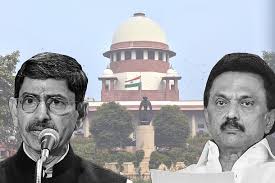
NewDelhi: The Supreme Court on Friday issued notices to the Union government, the office of the Tamil Nadu Governor, and the University Grants Commission (UGC) on a plea filed by the Tamil Nadu government challenging a Madras High Court order that stayed new state laws curtailing the Governor’s role in appointing vice-chancellors (VCs) to state universities.
According to a Hindustan Times report, the state government approached the top court after a vacation bench of the high court, on May 21, granted an interim stay on the operation of nine state laws. These laws, passed by the Tamil Nadu Assembly earlier this year, transferred powers related to the appointment, eligibility, and removal of university VCs from the Governor, who traditionally acts as Chancellor, to the state government.
A Supreme Court bench of Justices PS Narasimha and R Mahadevan sought responses from all three parties while hearing the state’s special leave petition. The court, however, refrained from commenting on the merits of the dispute and limited itself to issuing formal notices.
Representing Tamil Nadu, senior advocates Abhishek Manu Singhvi, Rakesh Dwivedi, and P Wilson submitted that the high court acted in “undue haste” by staying the operation of the state legislation without giving the government an adequate opportunity to file a counter-affidavit or present its arguments.
“The high court granted interim relief that amounts to granting final relief, and it did so without hearing the state or seeking a formal response,” argued Singhvi, as per the Hindustan Times report.
The state also requested the Supreme Court to allow the Madras High Court to proceed with hearing its application to vacate the interim stay, which is listed for July 14.
However, Solicitor General Tushar Mehta, appearing for the UGC, opposed this request. He pointed out that Tamil Nadu has also filed a transfer petition seeking to move all related matters to the Supreme Court. “You cannot seek transfer of the case to the top court and simultaneously push for orders from the high court,” Mehta argued, adding that the state laws are “absolutely repugnant to the UGC regulations.”
Mehta emphasized that the UGC’s guidelines, which are central in nature, mandate that VCs must be appointed by the Chancellor, a role constitutionally assigned to the Governor in most states. He maintained that any deviation from this would be in direct violation of central norms.
The high court’s May 21 stay came during its summer vacation, in response to a public interest litigation (PIL) filed by advocate K. Venkatachalapathy. The petitioner challenged the constitutional validity of the state amendments, arguing that they violated UGC norms and were, therefore, ultra vires. The PIL contended that in a conflict between central and state laws within the Concurrent List, the central law must prevail.
In its ruling, the high court temporarily halted the implementation of the amendments, which removed the Governor’s authority to appoint VCs, allowed the state to set up search committees, determine eligibility, and even remove VCs from office.
The Tamil Nadu government, in its appeal before the apex court, argued that the high court’s vacation bench heard the PIL without any demonstrated urgency and listed the matter in violation of its own notification, which limits vacation hearings to “very urgent” matters. According to the state, the petitioner was affiliated with a political party and lacked legal standing.
The state further cited the Supreme Court’s April 8 ruling in State of Tamil Nadu vs Governor of Tamil Nadu, which held that several bills, re-enacted by the Assembly and previously withheld by the Governor, were deemed to have received assent. Many of these laws were related to the very issue of vice-chancellor appointments.
The Supreme Court, in that earlier ruling, had criticized Tamil Nadu Governor RN Ravi for reserving as many as 10 re-enacted bills for Presidential assent, instead of granting or withholding assent as required. The matter has since been referred to the President under Article 143 and remains pending before the apex court.
In its special leave petition, Tamil Nadu underscored the constitutional principle that laws passed by a legislature enjoy a strong presumption of constitutionality. Citing the 2014 Constitution Bench decision in State of West Bengal vs Committee for Protection of Democratic Rights, the state argued that courts must exercise restraint while issuing interim reliefs that effectively render duly enacted laws inoperative.
The Supreme Court is expected to take up the matter in the coming weeks after receiving responses from the Centre, the Governor’s office, and the UGC.
Bureau Report
Leave a Reply