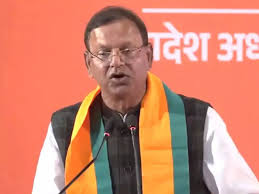
Union Minister of State for Finance Pankaj Chaudhary was unanimously elected president of the Bharatiya Janata Party’s Uttar Pradesh unit, a decision announced by Union Minister Piyush Goyal amid loud applause at the party headquarters in Lucknow.
Kurmi Influence in BJP’s OBC Strategy
OBC voters form the largest section of the population. Among them, Yadavs are considered the core vote bank of the Samajwadi Party. In such a situation, the BJP has been trying to consolidate non-Yadav OBCs in its favour. After Yadavs, Kurmis are the largest and most influential group. Their population is around 7–8%. Especially in Awadh, Bundelkhand and Purvanchal, Kurmis influence several seats.
By appointing Pankaj Chaudhary as the state president, the BJP has tried to attract Kurmi voters. The party has also earlier relied on Kurmi leaders. Before this, Om Prakash Singh, Vinay Katiyar and Swatantra Dev Singh, all from the Kurmi community, have served as state presidents. Pankaj Chaudhary is the fourth state president from this community.
Counter to SP’s PDA Strategy
The Samajwadi Party has persistently pushed the PDA (Backwards, Dalit, Minority) narrative and reaped gains from it. In the last general elections, the SP won 37 seats on its own, while the BJP was limited to 33. There were also reports that Kurmi voters had shifted from the BJP to the SP.
BJP Bets On Its Own Kurmi Face
Although Anupriya Patel and Ashish Patel of Apna Dal are part of the NDA alliance and the government, the BJP aims to build its own leadership from the Kurmi community. By appointing Pankaj Chaudhary as state president, the party is positioning him as its key Kurmi face.
Bureau Report
Leave a Reply