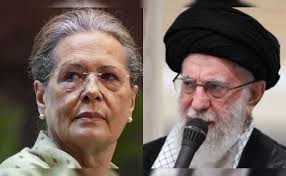
Senior Congress leader and Parliamentary Party chairperson Sonia Gandhi questioned the Modi government’s silence on the killing of Iran’s Supreme Leader Ayatollah Ali Khamenei.
Raising a serious doubt about the direction and credibility of foreign policy, she said that the central government’s silence, in this case, is not “neutral”, bur an “abdication”.
Sonia Gandhi also called for an open and direct debate on the government’s “disturbing silence” regarding the breakdown of international order when Parliament resumes the second part of the Budget session.
In her column for the Indian Express, former Congress president has written that India’s ties with Iran are “civilisational as well as strategic” and highlighted several occasions, when Iran came to help India.
“On March 1, Iran confirmed that its Supreme Leader, Ayatollah Seyed Ali Hosseini Khamenei, had been assassinated in targeted strikes carried out the previous day by the United States and Israel. The killing of a sitting head of state in the midst of ongoing negotiations marks a grave rupture in contemporary international relations,” Gandhi said.
She noted that, beyond the shock of the incident, what is equally starkly is New Delhi’s silence.
The Indian government remained silent and has not issued any condemning statement on Khamenei’s death but has urged restraint and de‑escalation in the Middle East, with government sources saying its cautious approach reflects that of other major world powers and prioritises national interests.
‘Initially, ignoring the massive US-Israeli onslaught, the Prime Minister (Narendra Modi) confined himself to condemning Iran’s retaliatory strike on the UAE without addressing the sequence of events that preceded it. Later, he uttered platitudes about his ‘deep concern’ and talked of ‘dialogue and diplomacy’ — which is precisely what was underway before the massive unprovoked attacks launched by Israel and the US,” Gandhi said.
“When the targeted killing of a foreign leader draws no clear defence of sovereignty or international law from our country and impartiality is abandoned, it raises serious doubts about the direction and credibility of our foreign policy,” Gandhi wrote in her article.
She highlighted that the assassination happened without a formal declaration of war and amid diplomatic talks, warning that if the world’s largest democracy remains silent, it could make the erosion of international norms easier to normalise.
“The unease is compounded by the timing. Barely 48 hours before the assassination, the Prime Minister returned from a visit to Israel, where he reiterated unequivocal support for the government of Benjamin Netanyahu, even as the Gaza conflict continues to draw global outrage over the scale of civilian casualties, many of them women and children,” Gandhi said.
She also reminded the central government about the Kashmir, saying, “In 1994, when sections within the Organisation of Islamic Cooperation sought to advance a resolution against India at the UN Commission on Human Rights over Kashmir, Tehran played a consequential role in blocking that effort. That intervention helped prevent the internationalisation of the Kashmir issue at a delicate moment in India’s economic trajectory.”
Earlier on Monday, Prime Minister Narendra Modi spoke with Saudi Prime Minister and Crown Prince Mohammed bin Salman and Bahrain’s King Hamad bin Isa Al Khalifa, thanking them for their support of the Indian community amid the volatile situation in West Asia. He also condemned the attacks on Saudi Arabia.
On Sunday, PM Modi held talks with Israeli Prime Minister Benjamin Netanyahu and UAE President Sheikh Mohamed bin Zayed Al Nahyan, urging de-escalation. However, he did not engage in direct discussions with the Iranian president or other senior Iranian leaders, reflecting a cautious approach to the situation.
Bureau Report
Leave a Reply