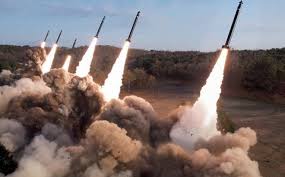
While the world’s attention remains gripped by the 15-day war between Iran and Israel, North Korea has opened a second front of geopolitical anxiety. In a massive display of force on Saturday, March 14, Pyongyang launched a barrage of at least 10 ballistic missiles toward the East Sea (Sea of Japan), prompting immediate high-level alerts in South Korea and Japan.
A massive saturday salvo
The South Korean Joint Chiefs of Staff (JCS) identified the synchronised launch at around 1:20 PM local time from the Sunan area near Pyongyang.
The scale: Unlike a single launch of a ballistic missile, this salvo of 10 missiles represents one of Kim Jong Un’s most aggressive tactical demonstrations this year.
The trajectory: Japanese Coast Guard officials verified that the projectiles had a ballistic trajectory before landing in the sea, outside of Japan’s Exclusive Economic Zone (EEZ).
Strategic timing: Exploiting the Middle East crisis
The strategic timing of this event is also being viewed by intelligence analysts as highly calculated.
Middle East distraction: While the United States and its allies are fully engaged in the Middle East theater in the conflict between Israel and Iran, this event is a clear attempt to test the limits of Washington’s “dual theater” response capability.
“Freedom shield” protest: The launch of these ballistic missiles comes at a time when there are ongoing “Freedom Shield” joint military exercises between the United States and South Korea. Pyongyang has always protested these military maneuvers because they are perceived to be an invasion rehearsal.
Defense gaps: There have been reports that the USA has redeployed some of its Patriot PAC-3 missile interceptors from South Korea to the Middle East to counter Iranian threats, which may have emboldened North Korea to test the defenses of the remaining air defense umbrella.
Neighbours on high alert
The response from the regional powers has been quick and coordinated:
South Korea: In response to the North Korean missile test, the JCS announced that the military is at “full readiness” and is sharing real-time tracking data with the USA and Japan.
Japan: The Japanese Prime Minister’s Office issued an emergency directive to gather information to ensure the safety of vessels and aircraft in the region.
United States: The Indo-Pacific Command of the USA condemned the North Korean missile test, stating that the recent tests highlight the “destabilizing impact of the DPRK’s illicit weapons program.”
A pattern of escalation
This is the third significant ballistic missile test conducted by North Korea this year. Experts believe that Kim Jong Un is accelerating his “Tactical Nuclear” doctrine, which is designed to prove that North Korea is capable of overwhelming the defenses of the regional powers with sheer numbers. This is similar to the “saturation strikes” that Iran used at the start of the current Middle East war.
As the smoke clears over the East Sea, the world is faced with the grim reality that the threat of a multi-front global war has graduated from the realm of theoretical threat to the realm of actual military challenge.
Bureau Report
Leave a Reply