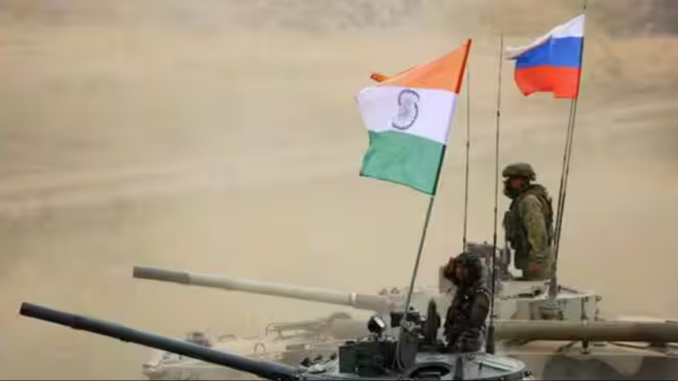
Russia: India’s ties with Russia have been not only strategic but also historic. While Prime Minister Narendra Modi and Russian President Vladimir Putin met twice last year, first in September 2025 in China and then in December 2025 in New Delhi. Putin is also expected to visit India in September this year for the BRICS summit. Ahead of the high-profile visit, India and Russia have incorporated the RELOS agreement, said reports.
RELOS comes into operation
The Reciprocal Exchange of Logistics Support (RELOS) agreement, signed in February 2025, is now operational. Russia has recently released documents related to the agreement, providing a clearer picture of its scope and intent.
The agreement facilitates deployment of up to 3,000 military personnel, along with 10 aircraft and 5 warships, on each other’s territory at any time. More importantly, it formalises mutual access to military infrastructure—ranging from army bases and naval ports to airbases, reported the NDTV.
While such logistics agreements are not new in global defence partnerships, the scale and provisions under RELOS signal a deeper level of operational trust, feel analysts.
Strategic depth for India
For India, the agreement extends its strategic footprint into regions that are becoming increasingly important in global geopolitics.
Access to Russian facilities in the Arctic, particularly Murmansk and the Northern Fleet hub of Severomors, offers New Delhi a foothold in a region that is rapidly emerging as a maritime and energy frontier. Similarly, access to Vladivostok in Russia’s Far East enhances India’s connectivity to the Pacific, reported India Today.
Russia’s Indian Ocean calculus
For Moscow, RELOS offers a different but equally significant advantage. Russia gains cost-effective logistical access to facilities in the Indian Ocean Region (IOR). This includes refuelling, repairs, and resupply support for Russian naval deployments. The agreement helps Russia by preventing massive investment in overseas bases, a move that often brings geopolitical pushback.
In practical terms, this allows Russian vessels to sustain longer missions in a region that is central to global trade and energy flows, without the political and financial burden of permanent basing.
Beyond logistics
The RELOS agreement is not limited to peacetime cooperation. It is designed to function in both war and peace, enabling faster deployment cycles and reducing operational costs for long-distance missions. The agreement also includes provisions for the exchange of goods and supplies, cost reimbursement mechanisms, and barter arrangements. and sustained logistical support for scientific and military missions
This flexibility makes it more expensive than traditional logistics pacts.
Move amid America’s Pakistan pivot
The move comes at a time when the United States of India is inclining more towards Pakistan. US President Donald Trump has time and again endorsed Pakistani Field Marshal Asim Munir’s leadership while keeping India ties on the back burner. Aware of the implications of America’s tilt towards Pakistan, India is keeping its cards open by closely cooperating with China and Russia.
A signal ahead of BRICS
The timing of RELOS becoming operational—just months before Putin’s India visit—appears deliberate. It signals continuity in Indo-Russian defence ties even as global alignments shift and geopolitical pressures mount.
In a world increasingly defined by blocs and rivalries, RELOS reflects a more pragmatic reality: partnerships are no longer exclusive, and strategic flexibility is becoming as important as strategic loyalty.
Bureau Report
Leave a Reply