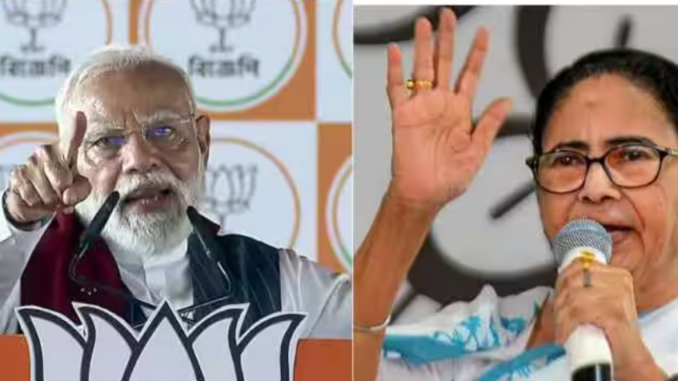
Kolkata: West Bengal today (April 23) goes to the polls for phase 1, with voting taking place across 152 constituencies. The contest opens a high-stakes electoral battle between the ruling Trinamool Congress (TMC) and the Bharatiya Janata Party (BJP), while several other parties also try to make space in a crowded political field.
More than 3.22 crore voters are eligible to cast their vote in this round. The remaining 142 seats will vote on April 29, and counting of votes will take place on May 4.
The final stretch of the campaign saw sharp exchanges between parties, large rallies and strong manifesto pitches from both sides.
Union Home Minister Amit Shah led the BJP’s final push with rallies across the state, where he targeted the TMC on issues like governance, corruption allegations, alleged infiltration and law and order. He also put forward a welfare-oriented agenda, promising financial support for farmers, women and unemployed youth.
At rallies in Dum Dum and other areas, he also attacked what he called “syndicate raj”, saying it would end if the BJP came to power.
The BJP also raised national security concerns and accused the TMC of running a system that benefits political networks and local groups. Shah also criticised the Congress leadership while campaigning in South 24 Parganas during a large roadshow held under tight security.
TMC pushes back with ‘bohiragoto’ narrative
The Trinamool Congress responded strongly to the BJP’s campaign, accusing its leaders of disrespecting Bengal’s culture and identity. The party criticised Shah over remarks related to Bengali poet Satyendranath Dutta by calling it a sign of disconnect with the state’s cultural roots.
TMC leaders have repeatedly described the BJP as “Bohiragoto” (outsiders) and said the party does not understand Bengal’s social and cultural background. The party said those who cannot engage with Bengal’s identity properly should not claim to represent it.
The TMC has also raised objections over alleged irregularities during campaigning, including claims about special train arrangements for voters coming into the state. The party called it an attempt to influence voters and demanded action from the Election Commission.
Political exchange
The BJP continued its attack on the TMC leadership, raising corruption allegations and governance issues. Party leaders also criticised what they called family-based politics in the state.
Top BJP leaders, including Nitin Nabin and Gaurav Bhatia, targeted the ruling party over corruption charges and governance concerns. Uttar Pradesh Chief Minister Yogi Adityanath also joined the campaign. He placed Bengal’s present situation within broader political themes.
Meanwhile, Opposition voices like Congress leader Sachin Pilot said voters in Bengal are looking for change, while AAP leader Arvind Kejriwal described the election as an important test for democracy.
Security and arrangements
The Election Commission has deployed extensive security arrangements across the state. More than 5,000 flying squads and over 5,300 surveillance teams are monitoring activities on the ground.
Strict checks are being carried out across districts, along with coordination between central and state agencies. Authorities have also imposed restrictions on rallies, motorcycle movement and night-time travel in several areas to prevent disturbances.
According to officials, these steps are aimed at ensuring a smooth and controlled voting environment.
At the same time, enforcement agencies have seized over Rs 1,000 crore worth of cash, liquor, drugs and other materials during the election period across West Bengal and Tamil Nadu combined.
Seats and contest zones
Several constituencies are seeing razor sharp contests this time. In Bhabanipur, Chief Minister Mamata Banerjee is contesting again, with the BJP fielding Suvendu Adhikari in a politically sensitive matchup. Nandigram is also under close watch, where Adhikari is once again the BJP candidate.
In Kharagpur Sadar, BJP’s Dilip Ghosh faces TMC’s Pradip Sarkar in a seat known for changing political trends. Murshidabad is another tight contest, where TMC and BJP candidates are locked in a close fight after a narrow margin in the previous election.
Urban seats such as Siliguri, Dum Dum Uttar, Tollygunj, Kolkata Port and Ballygunge are also witnessing nail-biting contests, with senior TMC leaders contesting in important races.
In North Bengal, Darjeeling and Mathabhanga are also drawing attention due to competitive multi-party contests.
Manifestos and promises
Titled ‘Sankalp Patra’, the BJP’s manifesto focusses on job creation, financial support for women and farmers and welfare schemes. It also highlights measures related to governance and border issues.
The TMC criticised the manifesto by calling it a set of repeated promises and questioning its implementation record.
Meanwhile, both sides positioned their campaigns around governance, welfare delivery and political identity.
Voter list debate
One of the major issues during this election has been the Special Intensive Revision (SIR) of electoral rolls. Reports suggest that several lakh names have been removed from the voter list during the process.
The TMC has raised concerns about voter exclusion, while the BJP has defended the process as necessary for cleaning up records.
As polling begins across 152 constituencies, Bengal enters a decisive phase in its election cycle. With long-standing political rivalries, strong campaign narratives and a large voter base, the outcome of this phase will set the tone for the upcoming rounds of voting and the final results on May 4.
Bureau Report
Leave a Reply