NewDelhi: Aerial warfare in 2026 looks very different from what air forces trained for just a decade ago. Cheap and long-range loitering munitions, especially those inspired by the Iranian Shahed series, are now being used in large numbers across war zones. Their low cost and ability to fly long distances have forced militaries to rethink how they respond in the air.
Lessons learnt from wars in Ukraine and the Middle East suggest that using expensive air defence systems and high-end fighter jets against low-cost drones is not a practical long-term approach. This mismatch has pushed interest toward simpler aircraft that can do the job more efficiently.
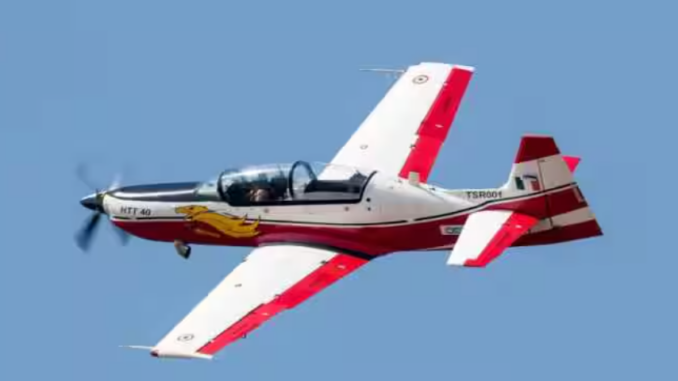
India is considering Hindustan Aeronautics Limited (HAL)’s HTT-40 trainer for this role. The idea is to modify it into a dedicated “drone hunter” that can target slow-moving aerial threats at much lower cost.
Why drones like Shahed are difficult to intercept
The challenge begins with how these drones fly. Systems such as the Shahed-136 usually travel at speeds of around 150 to 180 km/h and fly low to avoid detection. That creates a difficult situation for fast fighter jets such as the Rafale or Su-30MKI.
These jets are built for high-speed combat, not slow tracking. Their minimum safe speeds leave pilots with little time to align and engage small and slow targets. This makes interception more difficult and increases workload in the cockpit.
Why slower aircraft may work better
This is where turboprop aircraft come in. Unlike fast jets, they are built to operate efficiently at lower speeds. An aircraft such as the HTT-40 can match the speed of a loitering drone and stay along with it long enough for accurate targeting.
This approach is not only theoretical. Aircraft such as the A-29 Super Tucano and even older trainer platforms like the Yak-52 have already been used in combat situations to track and shoot down drones by flying close to them.
The cost equation behind the idea
The financial side of the problem is just as important. A modern fighter jet can cost around $20,000 to $25,000 per hour to operate. A light turboprop aircraft brings that down to roughly $1,000 to $2,000 per hour.
The weapons used also change the equation. Using million-dollar missiles against drones that cost a fraction of that creates a major imbalance. A turboprop platform allows the use of cheaper systems such as machine gun pods or guided rockets like the APKWS. It brings interception costs closer to the target’s actual value.
Why HTT-40 fits the role
Developed by the HAL, the HTT-40 is built as a stable trainer aircraft. It uses the Honeywell Garrett TPE331-12B engine and comes with a modern glass cockpit and strong low-speed handling.
To convert it into a drone interceptor, it would need added systems such as electro-optical and infrared sensors, a basic fire-control system and under-wing mounts for lightweight weapons. These changes are relatively straightforward compared to building a new aircraft from scratch.
Since the platform is low-cost, it could be produced in larger numbers and deployed to protect sensitive areas like airbases, logistics hubs and infrastructure.
Longer patrol time and operational advantage
One of the strongest advantages of turboprop aircraft is endurance. Loitering munitions are used in waves to overwhelm defences, and sustained air presence becomes important.
A squadron of modified HTT-40 aircraft could be in the air for long periods and maintain constant patrols. A single aircraft could potentially engage multiple drones in one mission, something that is difficult for fast jets due to fuel consumption and operational limits.
A lower-risk layer for air defence
Another practical point is risk management. Fighter jets are high-value assets, both in terms of cost and pilot training. Sending them into repeated low-value drone interceptions puts extra pressure on frontline resources.
A turboprop-based system reduces that pressure. Even if losses occur, replacing such aircraft is far easier compared to advanced fighters.
Not a replacement, but a supporting role
Despite these advantages, turboprops are not meant to replace fighter jets. Fast aircraft will still be needed for high-speed threats, enemy fighters and complex combat scenarios.
The idea is more about dividing roles. Fighters handle advanced threats, while turboprops take on the flow of slower drones. This creates a more balanced and practical air defence structure.
A possible new layer in India’s air defence
If integrated, an HTT-40-based interceptor squadron could add a new layer to India’s air defence network. It would offer a cost-effective way to deal with a growing class of aerial threats while also expanding the use of a domestically built aircraft under the broader “Make in India” push.
The concept is still evolving, but the direction is clear – future air defence may depend less on expensive missiles and more on simple and adaptable platforms doing specific jobs well.
Bureau Report
Leave a Reply