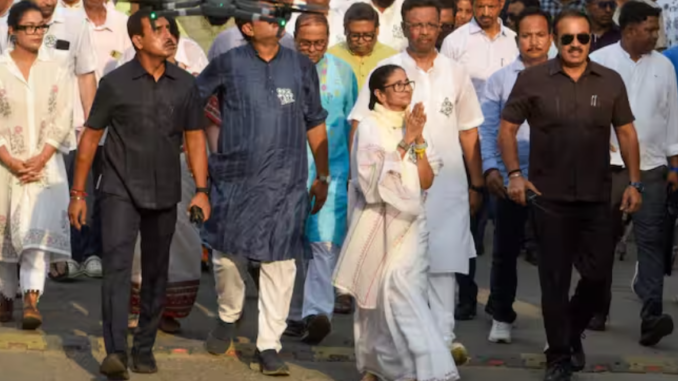
WestBengal: As campaigning in West Bengal draws to a close on Monday ahead of the second phase of assembly elections, the women’s vote has emerged as perhaps the most closely watched and least predictable factor in this election. All the first-time women voters, including the already ones, are facing the same dilemma: if the BJP comes to power, would they have to go all the way to Delhi every time they needed help?
The ‘Didi’ factor
In Bhabanipur, where Mamata Banerjee has won two bypolls and where her neighbours remember her wading through waterlogged streets during monsoons or sitting beside a grieving mother through the night, the attachment to her remains personal and deeply felt. Women in the area speak of her welfare schemes with genuine appreciation. The Lakshmir Bhandar scheme alone transfers Rs 1,500 per month to an estimated 2.4 crore women across the state. For many in lower-income households, that money is not a political gesture; it is a lifeline.
According to the reports, a woman at the Pyara Bagan slum in Bhabanipur said she would vote TMC because of what Banerjee had delivered, while acknowledging that a handful of women in her neighbourhood had quietly made up their minds otherwise. Her assessment was measured; the government would change eventually, but not yet and not suddenly.
A few streets away, however, the mood was noticeably different. A small group of women pointed skyward and said God would decide what happened on 4 May. One of them lowered her voice and said they wanted change, adding that the reasons were well known to everyone. An elderly woman passing by said it more plainly. This time, she said, Mamata was going, the reports added.
The distinction people are drawing
What makes this election particularly difficult to read is the gap between how people feel about the TMC as a party and how they feel about Banerjee personally. Dissatisfaction with the party is real and, by most accounts, deeper than what was being discussed a few weeks ago. Allegations of corruption, extortion and the unchecked conduct of local party functionaries have surfaced repeatedly in conversations across constituencies.
Yet that frustration has not translated into personal anger against the Chief Minister herself. People draw a clear line between the two. Even women who speak openly about wanting change tend to soften when Banerjee’s name comes up, acknowledging what she has done for them while criticising what the party around her has become.
Jobs, safety and inflation
Beyond personal loyalty, there are harder grievances that no welfare scheme has been able to fully absorb. Women at SSKM government hospital in Kolkata spoke about the absence of employment opportunities in the state. As per the reports, one of them said her daughter had completed her graduation and could not find work anywhere.
In the villages of Canning Purba and Canning Paschim in South 24 Parganas, traditionally a TMC stronghold, women said that inflation had effectively cancelled out the benefit of the monthly transfer they received from the government. The RG Kar rape and murder case and broader concerns about women’s safety also came up repeatedly as points of grievance, though none of the women raised the issue of the Constitutional Amendment Bill on women’s reservation, which the TMC voted against in Parliament.
Mamata’s political calculus
With her back against the wall, Banerjee has leaned heavily on Bengali identity in this campaign, framing the BJP as an outsider force synonymous with Delhi and warning that a change in government would alter the state’s cultural character, its food, its language and its ways of worship. TMC leaders at street-corner meetings across the state have consistently pushed this line, and it has found a receptive audience in a state that has historically resisted centralising influence.
The BJP has attempted to counter this narrative directly. Leader Anurag Thakur ate fish on camera in a pointed gesture of cultural solidarity, while Home Minister Amit Shah pledged that a BJP chief minister in Bengal would be someone born, educated and rooted in the state.
The bigger picture
Mamata Banerjee is contesting her fourth successive bid for the chief minister’s post, and most political observers agree this is the toughest fight of her career, harder, many say, even than the battle she waged to unseat the Left Front in 2011 after 34 years in power.
Her record is, by any measure, remarkable. She broke from the Congress, replaced it in Bengal, dismantled a Left government that had seemed immovable, and has held the BJP, which grew from three seats in 2016 to 77 in 2021, at bay across five successive elections. She comes from no political family and built everything herself, a fact that continues to add to her appeal among ordinary voters.
Nobody yet knows how the deletion of 91 lakh names from the electoral rolls will affect the final result, or what the unprecedented 93.2 per cent voter turnout in the first phase on 23 April actually signals. What is clear is that the women of Bengal are not voting as a bloc. They are weighing loyalty against frustration, welfare against aspiration, and trust in one woman against their doubts about the party she leads.
Bureau Report
Leave a Reply