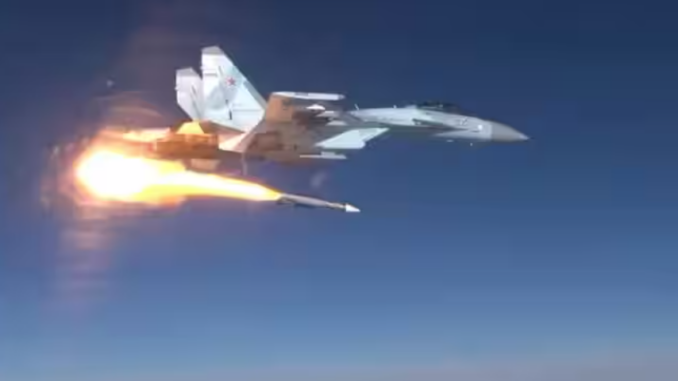
NewDelhi: India is set to add one of the world’s longest-range air-to-air missiles to its fighter fleet after the Defence Ministry signed a deal with Russia for 300 R-37M missiles, according to multiple media reports. Valued at more than $1.2 billion, the agreement is expected to strengthen the combat reach of the Indian Air Force (IAF)’s Sukhoi Su-30MKI fighters, which continue to serve as the backbone of India’s air combat fleet.
The move follows reports from early March that India was considering a large-scale purchase of several hundred R-37M missiles. The missile is regarded as the longest-range air-to-air missile ever exported by Russia and is matched only by China’s PL-17 and the American AIM-174 in terms of range.
Defence analysts believe the induction of the R-37M could nearly triple the engagement range of India’s Su-30MKI fighters. The missile purchase has also come at a time when New Delhi is moving ahead with plans to modernise the aircraft fleet with Russian assistance.
Su-30MKI upgrade plans gather pace
Reports about the missile deal surfaced shortly after confirmation in late February that the Defence Ministry would proceed with a major upgrade programme for the Su-30MKI fleet. The first phase of the upgrade is expected to cover 84 aircraft.
The modernisation package is likely to include new radars, electronic warfare pods and the integration of the R-77M air-to-air missile.
The R-37M itself was originally built for the Mikoyan MiG-31BM interceptor, one of the heaviest combat aircraft currently in service anywhere in the world. Since the Su-30MKI is also a heavyweight fighter platform, experts believe it can carry the missile without major impact on flight performance.
The IAF has been pushing to strengthen its long-range aerial combat capabilities as regional air power competition continues to grow. Officials and analysts see the R-37M as a major addition because of its ability to target aircraft at extremely long distances.
Missile can hit targets up to 400 km away
The R-37M combines a reported engagement range of 350 to 400 kilometres with a 61-kilogram warhead and speeds reaching Mach 6. Military observers say this combination could improve the combat capability of the Su-30MKI fleet.
The missile was built to work with the powerful radar systems carried by the MiG-31BM. The Su-30MKI presently does not have radars of similar power, which means the missile may not initially operate at its maximum potential when relying only on onboard sensors.
That situation may change after the planned radar upgrades for the Su-30MKI fleet. Analysts also point out that targeting support from India’s S-400 Triumf systems, and possibly in the future from the Sukhoi Su-57 fighter, could help unlock more of the missile’s full capability.
India steps up push for Russian air combat systems
The R-37M purchase is part of a wider Indian effort to strengthen its air warfare network with advanced Russian systems. In late March, the Defence Ministry approved a plan to acquire 10 battalions of S-400 long-range air defence systems.
Earlier in January 2026, the ministry also confirmed that talks to procure the Su-57 stealth fighter had reached an advanced technical stage. Interest in the aircraft gained momentum after reports in June 2025 said Russia had offered India full access to the fighter jet’s source code, something rarely offered in defence deals.
Military experts believe the combined impact of upgraded Su-30MKI fighters, new long-range missiles, next-generation stealth aircraft and advanced air defence systems could dramatically strengthen India’s aerial combat capabilities over the coming years.
Pakistan engagements said to influence decision
Reports suggest India’s interest in the R-37M may also have been influenced by recent military developments involving Pakistan. Analysts have pointed to the use of 40N6 long-range missiles from S-400 systems during engagements in March, where the systems were reportedly used to disrupt Pakistani support operations.
The incidents highlighted the value of striking high-value airborne assets, including electronic warfare aircraft and airborne early warning and control systems, from long distances and even deep inside hostile territory.
The latest Russian defence deal also comes at a time when France has faced difficulties promoting the Dassault Rafale fighter jet during negotiations with India. Reports have suggested that one reason has been disagreements over technology transfer demands raised by New Delhi.
Leave a Reply