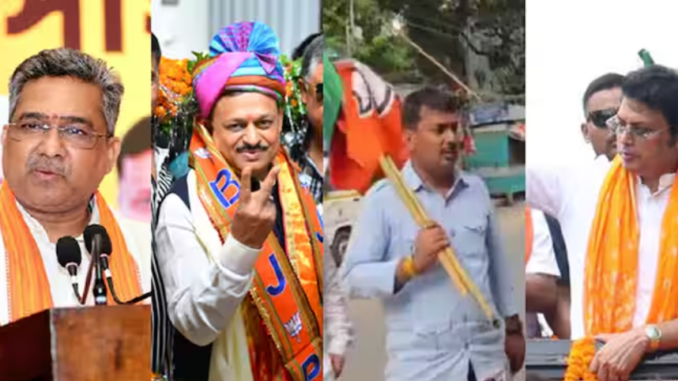
WestBengal: The Bharatiya Janata Party has secured a decisive mandate in West Bengal with 207 seats. While Union Home Minister Amit Shah and Prime Minister Narendra Modi were the face of the BJP’s aggressive campaign push, there are dozens of senior party leaders, including Chief Ministers of the BJP-ruled states, who worked on the ground without much fanfare and ensured that the saffron tsunami was ensured in a state ruled by the TMC for 15 years.
Among the silent strategiest were Sunil Bansal and Rajendra Rathore, who got special mention from even Suvendu Adhikari, the leading face in the Chief Ministerial race. Notably, after defeating Mamata Banerjee from the Bhabanipur seat, Adhikari thanked Rajendra Rathore for holding the fort for him at the seat even in his absence. Accompanying Rathore were 10 Rajasthan MLAs who worked anonymously in multiple Bengal seats, listening to the local people and their grievances, sending the feedback to the top BJP leaders who incorporated the issues in their rally speeches.
Sunil Bansal, the BJP National General Secretary and West Bengal party observer, is widely recognised as the chief architect behind the BJP’s historic victory in the 2026 West Bengal Assembly elections. Bansal’s primary contribution was shifting the party’s focus from “mega rallies” to hyper-local organisational strength. He implemented a strategy focused on managing approximately 80,000 individual booths across the state. He deployed a core team of over 1,500 trained party workers from other states (like UP and Chhattisgarh) to Bengal. These workers spent months on the ground, training local “Panna Pramukhs” and booth committees.
Union Minister Bhupender Yadav served as a cornerstone of the BJP’s organisational victory in West Bengal, specifically as the election in-charge appointed in September 2025. Known as the party’s “committee man” and a seasoned poll manager, his role focused on professionalizing the campaign and managing internal dynamics. He reportedly toured districts so quietly that even local BJP leaders often didn’t know his schedule. This helped him get an unfiltered view of the grassroots sentiment without the “pomp” of a VIP visit.
Uttar Pradesh Chief Minister Yogi Adityanath held strategic rallies in West Bengal’s seats where the margins were quite narrow for the BJP to beat the TMC. His rallies worked wonders and the BJP secured those seats. However, at the ground was BJP’s Kanpur MP Ramesh Awasthi, who was given a responsibility for 29 seats. Out of these 29, the BJP secured victory in at least 23 seats. Apart from this, Ramesh Awasthi was also entrusted with key administrative responsibilities. Showing confidence in his abilities, the party leadership assigned him an important role in the national team as an in-charge observer. He stayed in West Bengal for over two-and-a-half months, working round the clock to strengthen the organisation and execute the election strategy successfully. He was also responsible for the managing rallies of PM Narendra Modi, JP Nadda, Amit Shah and Yogi Adityanath.
While Chhattisgarh Chief Minister Vishnu Deo Sai held rallies in Bengal, on the ground were some state BJP MLAs like Sushant Shukla who were putting BJP flags in the TMC bastion. Sushant Shukla was spotted putting BJP flags in Kolkata’s Lake City and adjoining constituencies as a simple party worker and not as an MLA.
Biplab Kumar Deb, the former Chief Minister of Tripura, played a central and highly influential role. Recognised as a key “Bengal strategist” by the BJP central leadership, his involvement was not just limited to campaigning but extended to high-level organisational planning. In September 2025, the BJP appointed him as the co-incharge for the West Bengal elections, working directly alongside Election In-charge Bhupender Yadav and General Secretary Sunil Bansal. He was tasked with bridging the gap between the central leadership and the West Bengal state unit. His experience in toppling a long-standing Left government in Tripura (2018) was seen as a vital asset in challenging the TMC’s 15-year rule.
Leave a Reply