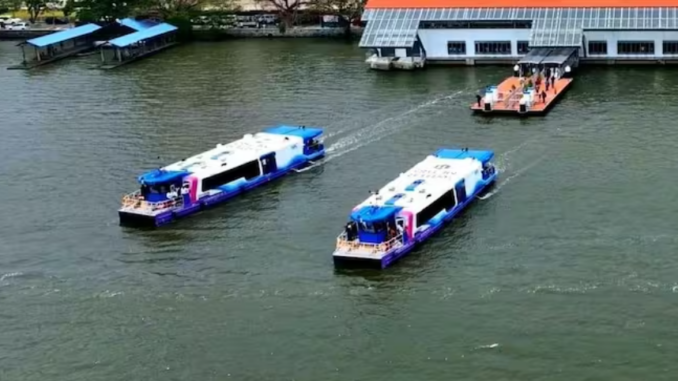
Guwahati/Patna/Ayodhya: Soon, your city will have a water metro just like Kochi. After the success of Kochi Metro, the government has actively been considering the idea of implementing it across India, especially to the cities bordering water bodies like rivers and sea. Union Minister of Ports, Shipping & Waterways (MoPSW), Sarbananda Sonowal chaired a review meeting on the rollout of the much-anticipated Water Metro services in the country on Monday. Building on the success and learnings from the Kochi Water Metro, the Modi Government is now scaling up a national framework to introduce water-based urban mobility solutions across cities with navigable waterways. The proposed rollout aims to transform inland waterways into efficient, sustainable, and modern public transport corridors.
Water Metro Phase-1 Cities
The Centre has advanced plans to roll out Water Metro services in 18 cities, with Guwahati among those identified for Phase I, Union Minister Sarbananda Sonowal informed. Cities including Srinagar, Patna, Varanasi, Ayodhya and Prayagraj are also part of Phase I, while Tezpur and Dibrugarh in Assam have been proposed for Phase II of the project. The Ministry has simultaneously circulated the Draft National Water Metro Policy, 2026 for inter-ministerial consultations, indicating a push to formalise a national framework for urban water transport.
Water Metro Feasibility Studies
The Inland Waterways Authority of India (IWAI) had entrusted Kochi Metro Rail Limited (KMRL) with conducting feasibility studies for 18 cities on 25 February 2025. The study covers assessment of existing public transport systems, travel demand estimation, financial and economic viability (FIRR and EIRR), and multimodal integration. As per the current status, site visits have been completed for all 18 locations, while draft feasibility reports have been submitted for 17 cities, with Lakshadweep pending. Feasibility reports for Srinagar, Patna, Guwahati, Varanasi, and Ayodhya have already been accepted.
Speaking on the Draft National Water Metro Policy 2026, Sarbananda Sonowal emphasised that India’s rich maritime heritage must be reflected in the design and architecture of terminals and associated infrastructure. He stressed the importance of conducting thorough “landscape assessments and using locally appropriate building materials to preserve regional identity”.
Why Water Metro
Highlighting the rationale behind the initiative, Union Minister Sarbananda Sonowal underscored that the proposed Water Metro systems are significantly less capital intensive as they utilise existing waterways with minimal civil infrastructure while enhancing connectivity.
“With faster construction timelines, lower land requirements, and reduced operational costs, particularly through the adoption of electric and hybrid ferries the system offers a viable and eco-friendly alternative to conventional urban transport. These services will contribute to reducing congestion in cities while offering a comfortable, scenic, and smoother commuting experience,” said Sonowal.
Consultation With State Governments
Union Minister Sarbananda Sonowal emphasised on the need for consultation of the Draft National Water Metro Policy, 2026 with the State Governments too for receiving their valuable suggestions on the same. The proposed Water Metro system is envisioned as a mass public transport solution catering to both daily commuters and tourists. It will operate across all navigable waterways.
Union Minister Sarbananda Sonowal added, “A strong emphasis has been placed on green technologies, with hybrid and electric propulsion systems encouraged alongside periodic technological upgrades.” The initiative adopts an ecosystem approach, ensuring standardisation in vessel design, terminals, charging infrastructure, and safety protocols, while promoting indigenisation in vessel construction and seamless multimodal integration with existing transport networks.
Water Metro Planning Criteria
Outlining the planning criteria, Union Minister Sarbananda Sonowal said that water Metro projects will be prioritised in regions with suitable geographic conditions, including continuous or semi-continuous waterways. “Cities with populations exceeding one million and with demonstrated transport demand, particularly in tourist corridors, will be considered,” he said. However, these criteria may be relaxed in cases where projects significantly reduce road congestion, improve connectivity to remote or water-locked areas, or enhance resilience during floods and disruptions.
The development framework adopts a comprehensive ecosystem approach encompassing vessels, pontoons, jetties, bunkering & charging infrastructure, terminals, passenger amenities, and navigational aids. Multiple funding models are under consideration, including joint Centre-State funding, fully State-funded projects, Public-Private Partnerships (PPP), & fully Centre-funded initiatives. The Ministry has emphasised cost optimisation strategies through efficient planning, fleet rationalisation & operational management to ensure long-term viability.
Leave a Reply