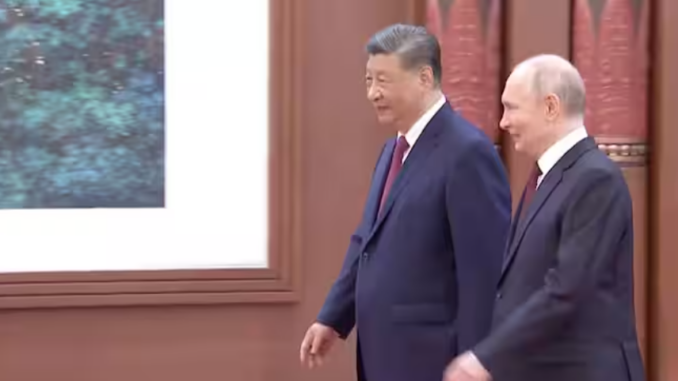
Beijing/Russian: President Vladimir Putin arrived in Beijing on Tuesday night for a State Visit to China and was given a grand welcome. By rolling out a magnificent welcome for Putin, China sent a message to Trump that Beijing can’t be bullied. Even Russian media outlets noted that Putin appears to have received a higher-level airport reception in Beijing than Trump did last week. Notably, Putin was received by Chinese Foreign Minister Wang Yi, a serving Politburo member, whereas Chinese Vice President Han Zheng received Trump at the airport. Notably, Zheng is no longer a member of the Politburo or the Communist Party’s Central Committee. When China sends a Politburo member to receive a guest, it shows the importance assigned to the visitor. Unlike Trump, Putin was greeted at the aircraft stairs by China’s foreign minister, a guard of honour, and children dancing and chanting welcome greetings.
Putin’s 25th China Visit
At the invitation of Chinese President Xi Jinping, Putin is visiting China from May 19 to 20. This is Putin’s 25th visit to China. The two Presidents will exchange views on bilateral relations, cooperation in various fields, and international and regional issues of mutual interest, according to China’s foreign ministry.
This year marks the 30th anniversary of the establishment of the China-Russia strategic partnership of coordination and the 25th anniversary of the signing of the China-Russia Treaty of Good-Neighbourliness and Friendly Cooperation, Xinhua news agency reported.
Earlier on Tuesday, Putin said, Russia-China relations have reached “a truly unprecedented level,” in a video address delivered before his state visit to China. The special nature of Russia-China relations is reflected in the atmosphere of mutual understanding and trust, a commitment to pursuing win-win and equitable cooperation, conducting respectful dialogue, and supporting each other on matters affecting the core interests of both countries, including protection of sovereignty and state unity, he said.
Why Russia-China ties are ‘too big to fail’
Vladimir Putin and Xi Jinping, two deeply entrenched leaders with nearly four decades of combined rule, show no intention of relinquishing power. Their nations are bound by a multitude of strategic incentives, beginning with a shared 4,300-kilometre border that has transitioned from a historical flashpoint into a zone of stability.
Furthermore, their economies are highly complementary:
* Russia serves as a premier supplier of natural gas, crude oil, and essential raw commodities.
* China boasts a massive industrial base that acts as a voracious consumer of these resources.
The Impact of Western Isolation
Prolonged economic sanctions from Western nations have steadily forced Moscow to pivot toward deeper commercial integration with Beijing. While China stands as Russia’s premier trading partner, the relationship is heavily lopsided; Russia accounts for a mere 4% of China’s global trade volume. Beijing dominates exports to its northern neighbour, backed by an economy that dwarfs Russia’s. As Moscow’s ties with the West continue to deteriorate, China has evolved into Russia’s primary partner for acquiring technical, scientific, and industrial expertise.
Sustaining the War Machine
Following the 2022 full-scale invasion of Ukraine, the Kremlin’s reliance on Chinese components to sustain its military operations has intensified. According to data from Bloomberg, China now supplies over 90% of Russia’s restricted technology imports—marking a 10% year-over-year surge.
Interdependence and Vulnerability
Moscow possesses virtually no viable alternatives to Beijing, whose massive market and purchasing power are vital to Russia’s economic endurance. If China were to scale back its trade, Russia’s foreign policy goals would face severe complications given its severed ties with Western nations. While the growing power imbalance between the two capitals exposes a long-term vulnerability for Moscow, any forecasts of an imminent fracture in the alliance appear highly improbable for the foreseeable future.
Leave a Reply