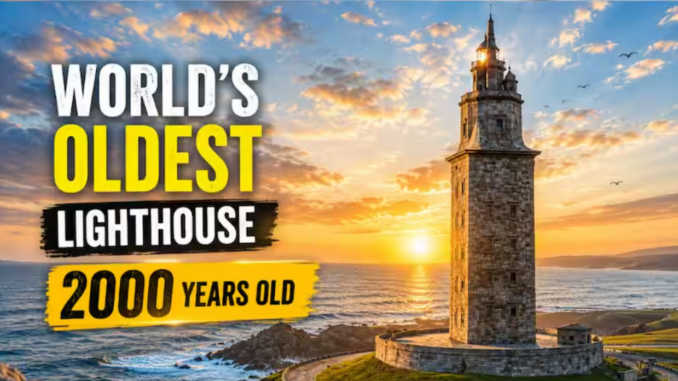
Coruña/Galicia: Oldest lighthouse in the world: The world’s oldest lighthouse still in operation is the Tower of Hercules (Torre de Hércules), located in La Coruña, Galicia, northwestern Spain. Built by Roman architect Caius Sevius Lupus during the reign of Emperor Trajan between 98 and 117 CE, it has guided sailors for nearly two millennia. Standing 55 metres tall on a 57-metre-high rock, it holds an official Guinness World Record and became a UNESCO World Heritage Site in 2009.
The Tower of Hercules is the world’s oldest lighthouse still in operation, and it has been doing its job for nearly 2,000 years. Guinness World Records officially recognises it as the oldest working lighthouse on Earth. It was built by the Romans in the late 1st or early 2nd century CE, and it still guides ships along Spain’s Atlantic coast today.
The tower stands on a peninsula about 2.4 kilometres from the centre of A Coruña, in the Galicia region of northwestern Spain. It sits at latitude 43.4°N and overlooks the North Atlantic. The location was strategically chosen by the Romans to guide ships navigating the treacherous western coast of their empire, including routes towards Britain.
The tower rises 55 metres above ground and is built on a rock that itself stands 57 metres high, giving it commanding views of the ocean. Of those 55 metres, 34 metres are original Roman masonry. The remaining 21 metres were added during an 18th-century restoration. The original Roman structure stood 36 metres tall, with a 4-metre pinnacle where wood was burned as a beacon.
Roman architect Caius Sevius Lupus built the tower during Emperor Trajan’s reign, between 98 and 117 CE. It was originally called Farum Brigantium, after the nearby port. The name “farum” comes from the Greek word Pharos – the same name as the legendary Lighthouse of Alexandria, one of the Seven Wonders of the Ancient World, which likely inspired its design.
The tower got its interesting name from an old Celtic-Iberian legend. According to the story, the hero Hercules defeated Gerion, a giant king of Spain who had three heads and three bodies, at this place. After winning the battle, Hercules built a tall column to celebrate his victory. Over time, people believed this column became the lighthouse. By the 6th century, the nearby area was already called “Faro,” which means lighthouse in Spanish.
In the late 18th century, architect Eustaquio Giannini restored the tower in a Neoclassical style, adding two octagonal upper sections over the original Roman base. Crucially, the original Roman core was preserved intact. Archaeological excavations in the 1990s exposed the Roman foundations, confirming the structure’s ancient origins and revealing the remains of its original outer spiral ramp.
In 2009, UNESCO declared the Tower of Hercules a World Heritage Site – the only lighthouse from Greco-Roman antiquity to retain both its structural integrity and continuous function. The site draws hundreds of thousands of visitors annually and includes Iron Age rock carvings, a sculpture garden, and a nearby Muslim cemetery. It remains a fully operational lighthouse, guiding vessels to this day. (Images credit: magnific)
Leave a Reply