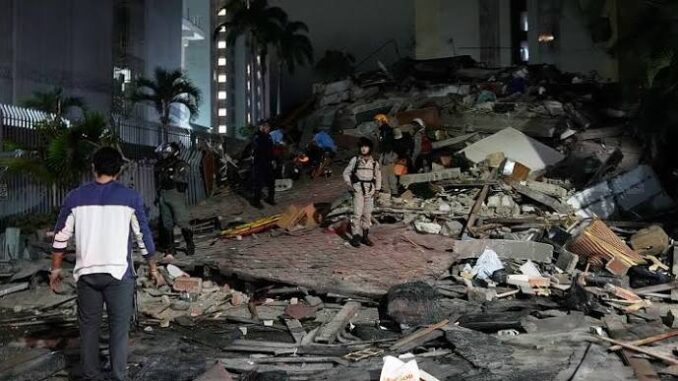
NewDelhi: The deadly earthquakes in Venezuela have led to a reality check on the risks faced by major Indian cities. In recent years, several tremors have hit many parts of India and led to the loss of thousands of lives. Mild tremors have also been felt regularly in Delhi and nearby regions.
According to geological classifications, nearly 59 percent of India’s landmass lies in earthquake-prone zones. Scientists divide the country into seismic zones from Zone 1 to Zone 5 based on underground tectonic activity. Zone 1 is the least risky. Zone 5 stands at the other extreme, where the danger is highest.
Delhi and the National Capital Region (NCR) are placed in Seismic Zone 4. That puts them in a bracket where earthquake risk is high compared to many other cities in India. In comparison, cities such as Mumbai, Kolkata, Chennai and Bengaluru are classified under Zone 3.
Experts say this makes the capital more sensitive to seismic activity. This is due to its proximity to the Himalayas, a region formed by the collision of tectonic plates that continues to experience underground movement.
Professor Mahesh Tandon, former head of the Indian Association of Structural Engineers, said Delhi’s risk is not limited to natural factors only.
“According to our estimates, 70-80% of buildings in Delhi have not been built to withstand even moderate earthquake shocks. The buildings that have come up over the past several decades along both the eastern and western banks of the Yamuna are a particular concern because most of them were constructed without proper soil testing,” he said.
A major issue for the capital is also its dense population and ageing infrastructure. With more than 15 million residents, the city has several old neighbourhoods and closely packed buildings.
A Supreme Court directive in 2025 had instructed that buildings housing 100 or more people must clearly display their earthquake safety rating, but implementation on the ground is limited.
Seismologists also refer to a fault line near Panipat, not far from Delhi, which adds to the region’s seismic sensitivity. They explain that while small tremors and aftershocks are expected in such zones, major earthquakes tend to follow long cycles that stretch across centuries.
Dr Kalachand Jain of the Wadia Institute of Himalayan Geology said, “It is not possible to predict the timing, location or magnitude of an earthquake. Seismic activity in the Delhi-NCR region has been occurring in patterns that cannot be ignored over time.”
Major earthquakes can affect areas as far as 250 to 350 kilometres away. The 2001 Bhuj earthquake is cited as an example, where damage extended far beyond the epicentre and affected Ahmedabad, which is nearly 300 kilometres away.
Historical records also show that Delhi-NCR has experienced major seismic events in the past. Research by experts, including studies based on Oldham’s catalogue of Indian earthquakes, refers to the 1720 earthquake as one of the most damaging incidents in the region. It is estimated to have been between magnitude 6.5 and 7.0. The quake caused heavy destruction in parts of Old Delhi, and aftershocks continued for months.
More recent earthquakes in Kangra (1905), Uttarkashi (1991) and Chamoli (1999) were also felt across northern India, including Delhi. It shows how seismic activity in the Himalayan belt is strongly linked across regions.
Experts say India has improved its disaster response systems over the years, but weaknesses still exist in preparedness at the building level.
Professor Santosh Kumar, former director of the SAARC Disaster Management Centre, said, “Concerns are based on estimates. If we take the Latur earthquake into account, it is clear that many buildings in Delhi are unsafe. But there are also several areas that are safe. The most important thing is that every citizen must be aware of such risks and governments ensure that rules are not violated at all.”
Urban safety specialists also stress the need for retrofitting older structures in Delhi, where thousands of buildings require seismic strengthening.
India has 29 cities identified as highly vulnerable to earthquakes, including state capitals such as Delhi, Patna, Srinagar, Guwahati, Shimla, Dehradun and Chandigarh. These cities fall largely along the Himalayan seismic belt, which is considered one of the most active earthquake zones in the world.
Seismologists continue to classify Indian regions into four main seismic zones, with Zones 4 and 5 carrying the highest risk. While northern and northeastern regions dominate the highest-risk category, experts say densely populated plains add another layer of risk due to the scale of potential damage in urban centres.
Bureau Report
Leave a Reply