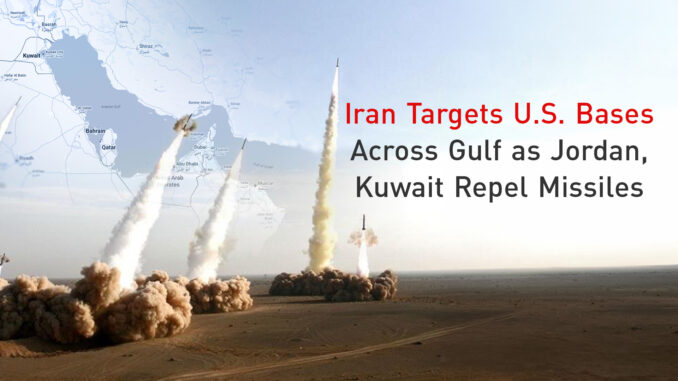
Iran on Monday claimed new missile and drone attacks on US military bases in Kuwait, Bahrain and Jordan. The latest action comes after recent US strikes on Iranian targets. Kuwait said its forces were dealing with aerial threats. Iran described the operation as retaliation. Meanwhile, the US said the Strait of Hormuz remains open and is not controlled by Tehran alone.
Iran says missile and drone attacks targeted US bases
According to Al Jazeera, citing Iran’s state-affiliated Nour News Agency, the Iranian Army and the IRGC launched “large-scale missile and drone attacks” on enemy bases in the region.
Iran said the attacks were part of its ongoing “eye-for-an-eye” operation. The official said targets were selected after monitoring enemy movements over the past 48 hours, Al Jazeera reported, citing an Iranian military official.
Jordan airbase targeted in first phase
In a statement, the IRGC said the first phase of the operation targeted Jordan’s Prince Hassan Airbase using missiles and drones.
The group claimed the attack caused fires at several fuel depots and ammunition storage facilities.
The IRGC also said the US strikes followed an operation by its navy to stop two ships in the Strait of Hormuz. It accused the vessels of switching off tracking systems, travelling illegally and creating risks for navigation.
Bahrain base hit in second phase
The IRGC said the second phase targeted Bahrain’s Sheikh Isa Airbase.
Iranian aerospace forces struck helicopter maintenance facilities, a hangar housing a P-8 aircraft and a US military drone command-and-control centre, as per the statement.
Kuwait airbases targeted in third phase
The IRGC claimed the third phase of the operation targeted Kuwait’s Ali Al-Salem Airbase and Ahmed Al-Jaber Airbase.
It said fuel tanks and Patriot air defence systems at Ali Al-Salem Airbase were destroyed. The statement also claimed a strategic FPS radar system at Ahmed Al-Jaber Airbase was hit.
The IRGC said the attacks were carried out by its aerospace forces during the third phase of its “eye-for-an-eye” operation.
It added that military operations were continuing and more results would be announced in future statements.
Iran warns over Strait of Hormuz involvement
The IRGC warned against further US involvement in the Strait of Hormuz.
It said Iran “would not allow continued foreign military interference” in the strategic waterway.
The organisation repeated that its retaliatory operations were ongoing and further updates would be released later.
US launched strikes on Iran a day earlier
The Iranian response came after US Central Command launched a major wave of strikes across multiple locations in Iran on Sunday.
According to CENTCOM, the operation targeted military installations to reduce Tehran’s ability to disrupt international maritime trade.
The strikes focused on Iranian air-defence systems, coastal radar sites, missile launch positions, drone launch facilities and small tactical vessels.
US forces used fighter aircraft, naval combat ships and, for the first time, one-way attack aerial drones and one-way attack sea drones.
CENTCOM says operation aimed to protect shipping routes
According to a CENTCOM statement, the military action was carried out to protect the Strait of Hormuz, one of the world’s most important maritime trade routes.
“The Strait of Hormuz is a vital maritime corridor for global trade. Iran does not control it,” the command stated.
The United States said the operation followed a period of growing tensions in the region. Washington accused Iran of aggression, harassment and threats against international commercial shipping.
On Sunday, US Central Command announced another round of strikes against Iran.
In a post on X, CENTCOM said the operation was ordered by the Commander in Chief and aimed at reducing Iran’s ability to target civilian mariners and commercial vessels travelling through the Strait of Hormuz.
“At 5 p.m. ET today, U.S. Central Command forces began launching more strikes against Iran to continue degrading their ability to attack civilian mariners and commercial ships freely transiting the Strait of Hormuz. The Commander in Chief has directed the strikes to hold Iranian forces accountable,” CENTCOM said.
US-Iran war
US and Iran are locked in a rapidly escalating regional war that erupted on February 28, with the US and Israel launching an intensive aerial campaign dubbed “Operation Epic Fury.” Iran retaliated with mass missile and drone swarms targeting Israel, US bases, and Gulf Arab states. After four months of intense fighting and severe global economic fallout, a ceasefire was brokered by Pakistan and Qatar on June 17, known as the Islamabad Memorandum of Understanding (Islamabad MoU). Several rounds of backchannel talks were held in Switzerland and elsewhere, including Geneva, to secure long-term stability; however, recently, US President Donald Trump said that the ceasefire is over following Iran’s aggressive efforts to enforce a transit fee on commercial shipping in the Strait of Hormuz.
Bureau Report
Leave a Reply