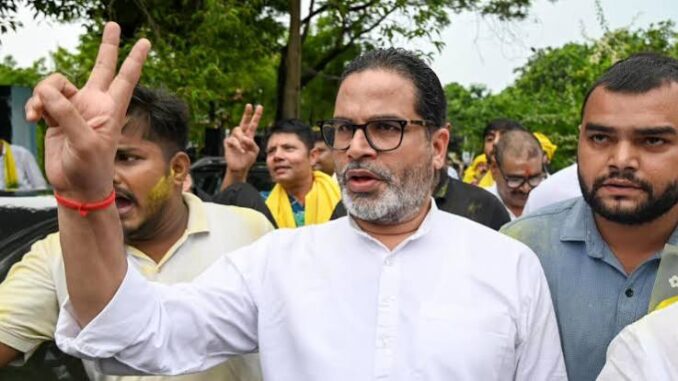
Jan Suraaj chief Prashant Kishor has pulled off a major political upset in Bankipur, wresting the Bankipur Assembly seat from the Bharatiya Janata Party (BJP) after nearly 31 years. The seat fell vacant after BJP national president Nitin Nabin moved to the Rajya Sabha.
Voting for the Bankipur Assembly by-election was held on July 30, 2026, with a turnout of 34.30 per cent. The result, declared on August 3, ended the BJP’s winning streak in the constituency that had continued since 1995.
The victory is significant for both Kishor and Jan Suraaj as it marks their first-ever win in an Assembly election. With the victory, Kishor has now entered the Bihar Assembly as an MLA. Bankipur, which has traditionally been viewed as a Kayastha-dominated seat, also broke with its political pattern this time by electing a Brahmin candidate.
The bypoll had turned into a prestige battle for Nitin Nabin, with the BJP putting its full organisational strength behind the contest. The party was not only looking to retain Bankipur but was also keen to secure a strong victory margin to maintain Nabin’s political standing at the national level.
But the contest did not go according to the BJP’s plan. Kishor defeated the BJP and also outperformed Mahagathbandhan’s RJD candidate Rekha Gupta, giving Jan Suraaj a crucial political breakthrough and strengthening Kishor’s credibility.
The BJP had attempted to weaken Kishor by bringing several Jan Suraaj leaders, both big and small, into its fold. It also sought to make the contest difficult for him and push him out of Patna. However, the strategy ultimately gave Kishor an opportunity to turn the focus back on local issues.
Instead of allowing the election to become solely a contest between political parties, Kishor took his campaign to the streets. He went door to door, interacted with residents and highlighted their everyday problems. He also raised the death of Bharat Tiwari, who was allegedly beaten by police in Bilauti, Ara, and spoke about issues involving lanes, drains, roads and concerns of Gen Z.
While the BJP continued to rely on its traditional organisational strength in Bankipur, Kishor kept walking through neighbourhoods, highlighting broken roads, mud and inadequate street lighting. The BJP, meanwhile, had deployed its entire party machinery in support of its candidate Neeraj Kumar Sinha.
Kishor also remained vocal in his efforts to win BJP workers to his side and supported Gen Z during protests linked to the NEET movement. As the founder of Jan Suraaj, he personally took the campaign to the ground through foot marches, street-corner interactions and ‘Chai Par Charcha’, pitching the message of systemic change.
The contrast between the campaign rhetoric and the concerns on the ground became increasingly visible. In areas such as Boring Road, Nala Road, Dariyapur Gola, Kadamkuan and Yarpur, voters were primarily concerned about waterlogging, traffic congestion, parking shortages and basic civic amenities.
For years, these local issues had remained a source of concern, with BJP MLAs representing the constituency for 31 years unable to provide what voters saw as a permanent solution to them.
Bankipur’s political history
To understand the significance of the result, it is important to look at Bankipur’s political history. The constituency was earlier known as Patna West. In 1963, Krishna Ballabh Sahay won the seat and went on to become Bihar’s Chief Minister. In 1967, Mahamaya Prasad Sinha won from the constituency and also became Chief Minister.
Sunil Mukherjee, the founding secretary of the CPI in Bihar, won the seat in 1972 and entered the Assembly. In 1977, Thakur Prasad, the Jan Sangh leader of that period and father of current Patna Sahib MP and former Union minister Ravi Shankar Prasad, also won from here.
The BJP first won Bankipur in 1995 and retained the constituency continuously thereafter. That year, Navin Kishore Prasad Sinha, father of Nitin Nabin and a kar sevak, won the seat. He continued to win until 2005. After his untimely death in 2006, the BJP fielded his son Nitin Nabin in the by-election, taking him into the Assembly for the first time.
Bankipur’s political identity has also been shaped by its sizeable Kayastha population. When the seat was known as Patna West, a significant section of its electorate belonged to the Kayastha community. Many of its prominent winners, including Mahamaya Prasad Sinha, Krishna Ballabh Sahay, Thakur Prasad, Dr AK Sen, who won on a CPI ticket and was a Bengali Kayastha, and Nitin Nabin’s father Navin Kishore Prasad Sinha, came from the community.
After delimitation, the constituency also acquired sizeable populations of Kurmis, Koeris and Yadavs. Even so, Kayasthas continue to constitute a large section of the electorate and are considered to have traditionally leaned towards the BJP.
That support had translated into a consistent BJP advantage in successive elections.
In the 2006 by-election, turnout was just 18 per cent, but Nitin Nabin secured a decisive 82.31 per cent of the votes to defeat Congress candidate Ajay Kumar Singh.
In 2010, Nitin Nabin received 72.06 per cent of the votes, with RJD’s Binod Srivastava finishing second.
Even after the formation of the Mahagathbandhan in 2015, Nitin Nabin retained the seat with 60.19 per cent of the votes, defeating Congress candidate Kumar Ashish.
In 2020, Nabin secured 59.05 per cent of the votes, while Luv Sinha, son of Shatrughan Sinha and the Congress candidate, finished second with 31.3 per cent.
The 2025 election again saw Nitin Nabin comfortably retain the seat with 63.24 per cent of the votes. RJD’s Rekha Kumari finished second with less than 30 per cent, while Jan Suraaj’s Vandana Kumari was third with just 5 per cent.
The 2026 bypoll, therefore, represents a sharp break from that established pattern. Local-level dissatisfaction among a section of the BJP’s traditional supporters, combined with Jan Suraaj’s strategy of turning that discontent into an electoral advantage, ultimately made it difficult for the BJP to hold on to its long-standing Bankipur stronghold.
Bureau Report
Leave a Reply