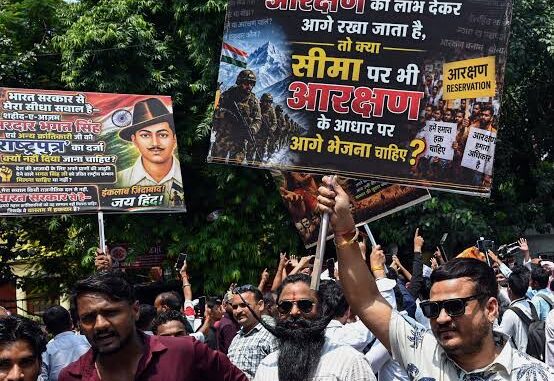
The Reservation Hatao Andolan (RHA) on Saturday claimed that the Centre has agreed to hold discussions with activists protesting against the existing caste-based reservation system, with the group saying a Union minister will “personally” meet the protesters. RHA, an Instagram-based campaign that has adopted mobilisation tactics associated with the Cockroach Janta Party (CJP), had urged its followers to gather at Jantar Mantar on Friday. The protest drew a large crowd. The organisation’s Instagram page has around 5.6 million followers.
“The government has agreed to discuss the demands of the activists of the reservation reform movement. Harsh Bhai has informed that a central minister will personally hold talks with the protesters,” RHA said in a post on X.
The group also suggested names it wants represented during the proposed talks, including right-wing influencer Ajeet Bharti, Neha Laldas and Anand Ranganathan.
“It is hoped that @ajeetbharti, @neha_laldas, @ARanganathan72, and others will also be included in this discussion. They can present these issues with much greater clarity and strength through their arguments and data,” the post said.
However, RHA stressed that the movement would continue. “Remember, the movement has not ended yet,” it added.
Protest At Jantar Mantar
Several protesters were detained by Delhi Police on Friday as a large crowd gathered at Jantar Mantar to oppose caste-based reservation.
Police and central forces were deployed at the protest site to maintain law and order. Barricades were put up and security personnel were stationed around the designated protest area as people began arriving for the demonstration.
The gathering took place despite Delhi Police stating that permission had not been granted for the protest.
On Thursday, police warned that social media posts claiming that permission had been granted for the August 21 demonstration were “false and misleading”. The force also said prohibitory orders under Section 163 of the Bharatiya Nagarik Suraksha Sanhita (BNSS), formerly Section 144 of the CrPC, were already in force in New Delhi district.
Police said protest marches, processions, demonstrations and assemblies involving five or more people were prohibited and warned that legal action could be taken against those spreading unverified information.
The clarification came after RHA’s Instagram page shared a poster announcing a “peaceful protest” at Jantar Mantar at 2 pm on August 21.
What Are The Protesters’ Main Demands?
The protesters have called for a wider review of the reservation system and raised several demands, ranging from greater weight to economic disadvantage to changes in the way quotas are implemented.
1. Greater Weight To Economic Condition
One of the central demands is that economic circumstances should play a greater role when deciding who receives government assistance.
Protesters said financial support for education, coaching, scholarships and related expenses should reach people who need it, irrespective of caste.
“Our demand is that economic conditions should be considered while deciding who needs government support. A poor person, irrespective of caste, should be provided assistance for education, coaching and other needs,” a protester associated with the Akhil Bharatiya Kshatriya Mahasabha said.
Another participant said, “We are not saying that economically weaker people should be left without support. We are saying that assistance should be targeted at those who need it, including through scholarships, fee support and coaching.”
2. Quota Within Quota
The protesters have also demanded a review of how the benefits of reservation are distributed within reserved categories.
YouTuber Ajeet Bharti called for a “quota within quota” system and questioned the government’s position on introducing a creamy-layer criterion.
“Why will you not implement it? It is so absurd that the government is bowing down to those few Dalit leaders who only talk about their caste group,” Bharti said while speaking to ANI.
3. White Paper On Reservation
Another key demand is the publication of a white paper examining the reservation system and its impact over the past eight decades.
Bharti cited the Musahar community in Bihar, arguing that some communities have not benefited adequately from reservation despite the system being in place for decades.
Other protesters also called for a review of the framework, arguing that India’s social and economic conditions have changed considerably since the policy was introduced.
“The circumstances have changed considerably over the decades. There should be a wider discussion on whether the existing framework needs to be reviewed and how economic disadvantage can be addressed without discrimination,” a participant said.
4. Minimum Marks For Higher Education
The protesters have also demanded minimum qualifying marks for admission to higher educational institutions, including premier institutes such as the IITs and IIMs.
“You cannot sell the dream of a developed India by compromising on merit. If 50% of the deserving youth or boys and girls who are studying will not get admission in the IITs, IIMs, or higher education, your efficiency has reduced by 50% right there,” Bharti told ANI.
5. Expanded EWS Benefits
The protesters have sought wider benefits for people classified as Economically Weaker Sections (EWS), including support related to application fees, hostel charges and course fees.
Bharti said, “Then the Economically Weaker Section (EWS) should be made a part of the Scheduled Castes (SC). The class whose definition says economically weaker, you are neither giving them a facility in buying the form, nor is waiving their hostel fee, nor is their course fee being waived; what will you achieve by merely recognising it?”
Apart from these five demands, protesters have also raised concerns about the Scheduled Castes and Scheduled Tribes (Prevention of Atrocities) Act and aspects of higher education policy, including the University Grants Commission framework.
The RHA’s latest claim of talks with the government comes as the reservation debate moves from social media mobilisation to street protests, with the group insisting that its campaign will continue until its demands are addressed.
Bureau Report
Leave a Reply