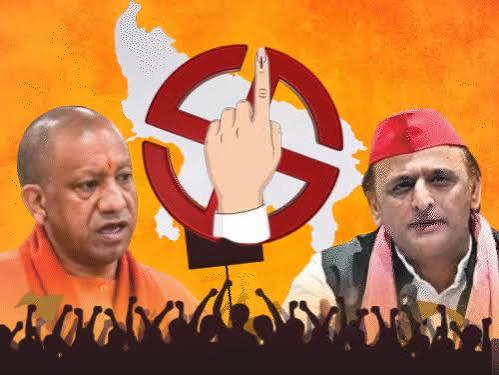
The ruling Bharatiya Janata Party (BJP) bagged four Uttar Pradesh Legislative Council seats, and the Opposition Samajwadi Party (SP) won one, even as the counting for the six remaining seats continued on Wednesday. The BJP was leading in the Gorakhpur Teacher and Agra Graduate seats. The SP was ahead in the Varanasi Graduate, Agra Teacher, Lucknow Graduate and Jhansi Graduate seats. If this trend continues, it will be a major gain for the SP, which won three of the 11 seats in 2020.
A BJP-SP clash in Agra and an Opposition boycott over alleged irregularities in Gorakhpur marred the counting process.
In 2020, the BJP won six of these 11 seats, and independents won two. The elections for the 11 seats were held on Friday, months before the assembly polls due in Uttar Pradesh next year. The BJP hopes to return to power in the state for a third time after the 2024 Lok Sabha election setback.
The Congress-SP alliance won 43 of the 80 seats in Uttar Pradesh and polled 43.52% of the votes in the 2024 polls. The BJP’s seats fell from 62 in 2019 to 33, dropping its overall tally below the majority mark in Parliament for the first time since 2014.
The BJP’s Dinesh Kumar Goyal, Shrichand Sharma, Hari Singh Dhillon and Umesh Dwivedi retained the Meerut Graduates, Teachers’ seats, the Bareilly-Moradabad Division Teachers’ seat, and the Lucknow Teachers Division seat. SP’s Lal Bihari Yadav won the Varanasi Division Teachers’ seat for a second consecutive term.
SP’s Aakash Agarwal maintained his lead over the BJP candidate after the second round of counting that ended at about 3am on Wednesday in Agra.
In Gorakhpur, SP candidate Sanjayayan Tripathi (Gorakhpur-Faizabad Teachers Division) boycotted the counting alleging irregularities. “Everything was going fine until the third round of counting.”
Tripathi said Independent candidate Rajeev Yadav was ahead by about 450 votes, but suddenly votes started coming entirely in favour of the BJP candidate one-sidedly. “Suddenly, the entire trend changed, and it felt like everything was pre-decided from before, so we boycotted the counting,” he said.
The counting began at 8am on Tuesday in Lucknow, Varanasi, Agra, Meerut, Jhansi, Bareilly and Gorakhpur. The process has been slow as ballot papers were sorted and bundled before counting under the single transferable vote system.
The polling for 28 legislative council seats was held in Uttar Pradesh, Bihar, Maharashtra and Karnataka on Friday.
Not every adult citizen is eligible to vote in legislative council polls and only six states, the other two being including Telangana and Andhra Pradesh, have a bicameral legislatures.
Bicameral legislatures were set up under the Government of India Act of 1935. A legislative council functions like the Rajya Sabha in the lawmaking process. Only those aged over 30 are eligible to contest legislative council polls, while the age limit for Lok Sabha and assembly poll nominees is 25.
Members of legislative councils (MLCs) are chosen for six-year terms through indirect elections, and one-third retire every two years.
The legislative council polls are not fought on party symbols, but political parties back candidates. They are held through proportional representation with a transferable vote. Electors list an order of preference and choose from a list of candidates.
Electorates comprising members of municipalities, district boards and such local authorities elect one-third of MLCs. Electorates residing in a state for at least three years and graduates of any university nationally or with equivalent qualifications elect one-12th of MLCs.
Electorates consisting of people with at least three years of teaching experience in a state at the level of secondary school and above choose one-12th candidates. The governor nominates the rest from people with expertise in areas like literature, science, and social service.
Bureau Report
Leave a Reply