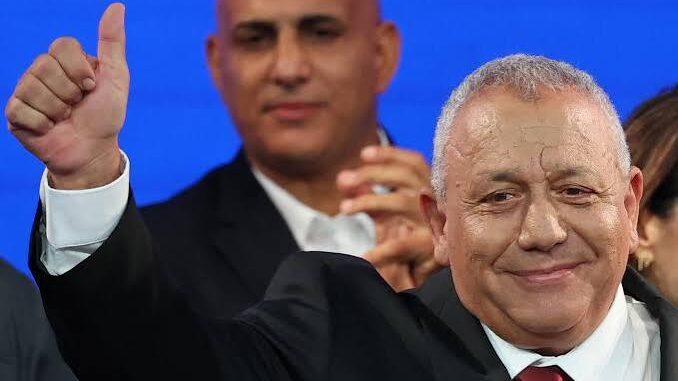
Israel’s political battle has taken a significant turn, with opposition leader Gadi Eisenkot securing the backing of 67 members of the incoming Knesset to receive the mandate to form the next government, putting him well ahead of Prime Minister Benjamin Netanyahu, who received recommendations from 46 lawmakers.
However, the numbers do not guarantee Eisenkot a clear path to power. Despite crossing the 61-seat majority mark in the 120-member parliament during consultations with President Isaac Herzog, several parties backing his candidature have yet to commit to joining an Eisenkot-led coalition.
The recommendations came during consultations at the President’s Residence on Thursday, November 5, following Israel’s October 27 parliamentary elections. The Arab-led Joint List unanimously decided to recommend Eisenkot, leader of the Yashar party, giving him a decisive lead over Netanyahu.
Herzog, however, has not yet formally assigned the mandate to either leader. At the conclusion of the consultations, he said he would hold further discussions with party leaders before announcing his decision on Sunday.
“The representatives of factions totaling 67 members of Knesset recommended the Leader of the Yashar! party, Gadi Eisenkot, to form a government,” Herzog said, adding that the ability to form a stable government remained unclear because of differences and vetoes within the political blocs.
Eisenkot, a former Israel Defence Forces (IDF) chief of staff, has pitched the idea of a “national emergency government” to restore political stability. In a post on X, he said the first round of consultations had concluded with an absolute majority of recommendations in his favour, but acknowledged that “the road ahead of us is still long”.
How Eisenkot Secured 67 Recommendations
Eisenkot’s support comprises 48 lawmakers from the Jewish-led opposition bloc, including Yashar, Together, The Democrats and Yisrael Beiteinu. The Arab-led Ra’am party contributed eight recommendations, while the Joint List added another 11.
The Joint List’s decision proved crucial. Its chairman, Yousef Jabareen, said the party wanted to preven Netanyahu and his right-wing allies from returning to power. He acknowledged disagreements with Eisenkot but said the decision was necessary to bring about a change in government.
Netanyahu, meanwhile, received 46 recommendations, down from the 53 seats his bloc was initially expected to command. The ultra-Orthodox United Torah Judaism (UTJ), which holds seven seats, refused to recommend either candidate, leaving the incumbent prime minister with a reduced tally.
Coalition Numbers Remain A Challenge
Despite the 67 recommendations, Eisenkot’s biggest challenge will be translating the numbers into a functioning coalition.
According to The Times of Israel, only 48 of the 67 lawmakers who recommended him are currently prepared to work together without conditions. The Joint List has indicated that it is willing to support an alternative government from outside the coalition but has ruled out formally joining it.
Differences over military service exemptions for ultra-Orthodox Jewish men could also complicate negotiations with UTJ. Meanwhile, Yisrael Beytenu leader Avigdor Liberman has reservations about depending on Arab parties for parliamentary support.
The president had also explored the possibility of a national unity arrangement during consultations, but Eisenkot’s camp has opposed sharing power with Netanyahu.
With Herzog expected to announce his decision on Sunday, Eisenkot has gained a significant political advantage. However, whether he can turn that backing into a stable government remains uncertain.
Bureau Report
Leave a Reply