Iran has widened its attacks across the Gulf, launching fresh strikes on Kuwait and Bahrain as the confrontation over the Strait of Hormuz continues to draw regional countries deeper into the conflict. The latest assaults mark Tehran’s first reported attack on Kuwait in more than two months and come amid an expanding US military deployment in the Middle East.
Kuwait’s military said it faced a wave of incoming drones early Wednesday, while Iranian state media claimed that the strikes targeted Ali Al Salem Air Base, which hosts US forces. Meanwhile, in Bahrain, missile alerts sounded twice before sunrise, with explosions reported across the island kingdom as air defence systems intercepted incoming threats. Bahraini authorities blamed Iran for the assault but did not immediately provide further details.
The attacks come amid a sustained campaign against Gulf states that have faced repeated Iranian strikes on military installations and critical infrastructure since the war began on February 28.
Kuwait And Bahrain Face Renewed Iranian Assaults
According to the London-based International Institute for Strategic Studies, Iran launched more than 1,200 drones and missiles towards Kuwait and over 700 towards Bahrain between the start of the war on February 28 and the ceasefire reached on April 8.
The United Arab Emirates, which faced the highest volume of incoming fire during that period, with more than 2,800 drones and missiles, has so far avoided attacks on its territory in the latest phase of the conflict. Saudi Arabia has also not faced fresh Iranian strikes during this period, although it continues to contend with threats from Yemen’s Iran-backed Houthi rebels.
Kristian Coates Ulrichsen, an expert at Rice University’s Baker Institute, said the attacks demonstrated that Iran retained both the capability and the intent to target US partners across the Gulf. He said the strikes also served as a reminder that regional governments remained vulnerable to retaliation linked to American actions around the Strait of Hormuz. Ulrichsen added that Washington’s military build-up did not give it exclusive control over how the conflict could escalate.
US Deploys Three Aircraft Carriers In Middle East
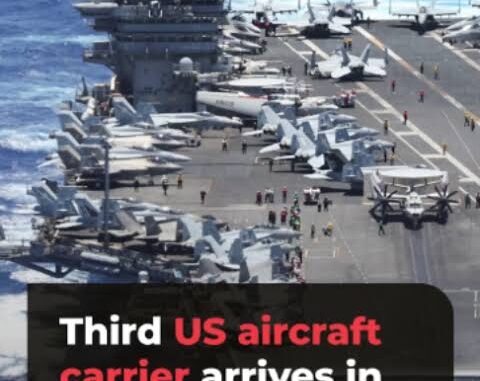
Amid all the chaos, the aircraft carrier USS Theodore Roosevelt has arrived in the Middle East and was seen sailing alongside the USS George Washington in footage released by the US military. This brings the number of aircraft carriers in the region to three, with the USS George H.W. Bush also deployed there. The California-based USS Boxer, a Wasp-class amphibious assault ship, is also operating in the region.
The growing naval deployment comes as Washington attempts to protect shipping through the Strait of Hormuz and maintain its military posture amid repeated Iranian attacks on vessels and regional targets.
Trump Administration Faces Pressure As Iran Conflict Continues
The latest strikes also come amid uncertainty over Washington’s diplomatic approach to ending the conflict. President Donald Trump has played down the Iranian attacks, but his administration has faced difficulties containing the fighting since the US midterm elections. Vice President JD Vance had reportedly considered direct talks with Iran as part of efforts to find a way out of the conflict.
However, Trump halted those efforts last week, declaring online that the United States did not need a deal with Tehran. Iran’s latest attacks on Kuwait and Bahrain now present another challenge for Washington. While the US continues to reinforce its military presence and protect shipping routes, Tehran’s ability to strike American partners across the Gulf underscores the risks of a wider regional confrontation.
Bureau Report
Leave a Reply