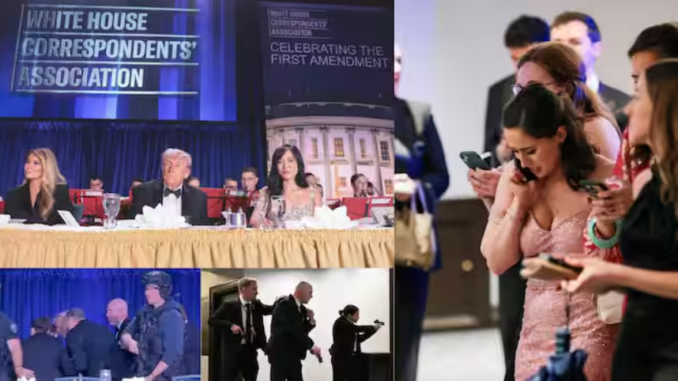
Washington: Donald Trump’s return to the White House Correspondents’ Dinner after years of boycott was meant to end his years of uneasy equation with the media. That made the sudden gunfire outside the venue even more jarring, as a rare face-to-face moment between the US president and journalists soon turned into a security scare just steps away from the event.
Trump’s relationship with the media has been tense for years. During his presidency, he repeatedly accused major news organisations of biased coverage and often used the term “fake news” to describe reports he disagreed with. Breaking with a tradition that most modern presidents have followed, he chose not to attend the dinner throughout his time in office.
He held campaign-style events or chose not to attend a room filled with journalists, editors and politicians. His absence turned into a talking point each year as the dinner went ahead without the sitting president, something rarely seen in recent decades.
His return this year was seen as a change in his approach. It placed him back in a setting where presidents are expected to engage, even briefly, with the press corps that covers them daily.
A tradition built on access and proximity
The White House Correspondents’ Dinner dates back to 1921 and is organised by the White House Correspondents’ Association. It began as a way for reporters covering the White House to interact with the president and senior officials outside formal briefings.
Over the years, it has grown into a political and media event, which is known for speeches, satire and moments where presidents address journalists. Leaders from both parties have used the dinner to show a willingness to engage with the press, even when relations were tense.
Presidents such as Barack Obama and George W. Bush regularly attended the event and used humour to ease tensions with reporters. Even when criticism was strong, the event showed the close, if uneasy, link between political power and media scrutiny.
A night that took an unexpected turn
This year’s dinner followed that same format until reports of gunfire near the entry point began to spread. The shots were fired near the screening area outside the ballroom, where guests pass through security checks.
Security teams quickly moved to escort Trump and other officials out of the venue.
Investigators say the attacker did not enter the ballroom but reached a checkpoint outside it. Reports suggest he may have been staying at the hotel, allowing him to move through parts of the building that are not under constant watch.
A volunteer quoted in US media said the suspect may have used an “unsecured room” near a terrace-level entrance before heading toward the screening zone. Authorities say he was carrying multiple weapons when he approached the checkpoint.
Officers engaged him when he did not stop. One officer was hit but protected by a ballistic vest. The suspect was overpowered and taken into custody within minutes.
The United States Secret Service said all protectees were safe. Trump later described the attacker as a “lone wolf” and said he was “taken down by some very brave members of Secret Service”.
Media, politics and a changed narrative
The timing of the incident has added another layer to Trump’s tense ties with the press. His return to the dinner was meant to place him back in direct contact with journalists after years of distance. But attention soon turned to the breach near the venue and how the attacker managed to get that close.
The dinner is held in a working hotel where public areas and secured spaces exist side by side. While the ballroom is tightly controlled, access points such as corridors and guest floors are difficult to monitor at all times.
Officials are now reviewing how the attacker moved through the building and reached the checkpoint with weapons. Officials are looking at access control and coordination across security layers.
Trump had intended the evening to show his return to a long-standing political tradition. It ended with questions about security and access taking priority over the rare moment he shared in the same room with the media.
Bureau Report
Leave a Reply