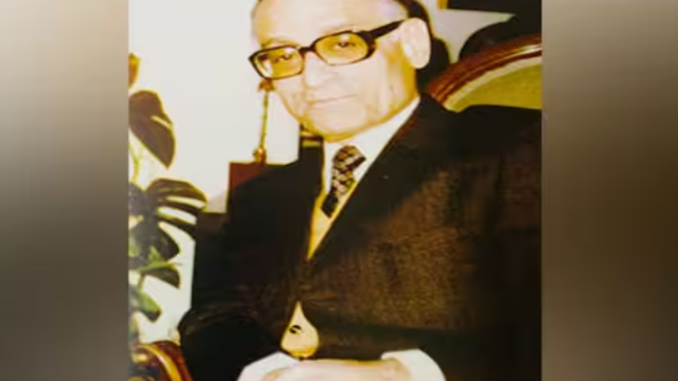
NewDelhi: The history of India’s intelligence has a few names that rarely come into public conversation, but their work has influenced some of the country’s biggest strategic decisions. One such name is Rameshwar Nath Kao, the first chief of India’s external intelligence agency, the Research and Analysis Wing (R&AW).
When the R&AW was set up in 1968, he was entrusted with building it up from the scratch. He led the organisation through its early years until 1977, setting up systems that allowed the country to track developments beyond its borders and relay inputs to policymakers in time.
Even after retirement, he kept a low profile away from public attention, but his role in developing India’s intelligence structure continues to be acknowledged by experts and officials.
Early life and education
Kao was born on May 10, 1918 in Varanasi in Uttar Pradesh into a Kashmiri Pandit family that originally belonged to Srinagar. He was raised under the guidance of his uncle, Pandit Trilokinath Kao, who played an important role in his upbringing and education.
His schooling began in Baroda, where he completed his matriculation in 1932 and intermediate studies in 1934. He then moved to the Lucknow University and earned a Bachelor of Arts degree in 1936. Later, he pursued a master’s degree in English literature from the Allahabad University.
His academic years coincided with a period when India was moving towards independence, and many young minds were beginning to think differently about public service and nation-building.
Entry into public service
After completing his education, Kao entered government service and later joined the police and intelligence field. His calm approach, observation skills and ability to handle sensitive assignments helped him move up.
He also served as the personal security chief of former Prime Minister Jawaharlal Nehru. In later years, he was appointed as security advisor to Ex-Prime Minister Rajiv Gandhi.
Apart from his intelligence work, Kao played a role in setting up institutions such as the Aviation Research Centre (ARC) and the Joint Intelligence Committee. He also served as the secretary (research) in the Cabinet Secretariat, a post that handled sensitive national security work.
Building R&AW from scratch
In 1968, the Government of India decided to create a separate external intelligence agency. Kao was given the responsibility of building it.
He worked on creating a structured system that could track developments outside India and provide timely inputs to decision-makers. Under his leadership, the R&AW developed its early structure, operational methods and coordination systems that became the foundation of India’s external intelligence network.
His approach was based on careful planning and quick execution rather than public visibility. Over time, the R&AW became one of India’s most important security institutions, and Kao’s role in its formation continues to be studied by those working in the field today.
Bureau Report
Leave a Reply