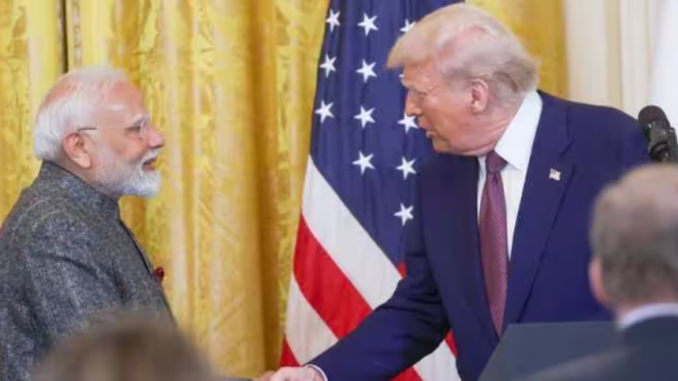
Washington: When Donald Trump on Thursday described India as a “hellhole”, he befouled Washington’s already dodgy ties with the two largest nations in the world, New Delhi and China. He lumped them together while justifying his immigration agenda and reposted a four-page racist screed by a supporter that accused both countries of exploiting America’s birthright citizenship privileges. For a community that makes up just 1.5 per cent of the United States’ population, Indian-Americans punch well above their weight, contributing an estimated six per cent of the country’s GDP. That is not the footprint of a people dragging a nation down. That is the footprint of a community holding a significant piece of it up.
Indian-Americans are, by most measurable standards, among the most settled and law-abiding communities in the United States. Crime statistics consistently place them at the very bottom of the table when it comes to arrests, convictions, and incarceration. While political rhetoric around immigration frequently conjures images of disorder and lawlessness, the data simply does not bear that out for this particular group.
It is, in fact, communities from several other parts of the world that feature far more prominently in American crime figures, a fact that makes the broad-brush targeting of India all the more difficult to justify. Indian immigrants, by and large, come to America, keep their heads down, build careers, raise families, and pay their taxes. They do not make headlines for the wrong reasons.
Woven into the American fabric
What is perhaps most striking is how thoroughly Indian-Americans have embraced life in the United States, not merely as residents, but as participants. They celebrate Thanksgiving, follow American football, send their children to local schools, join neighbourhood committees, and contribute to the civic life of their communities in ways that rarely get acknowledged.
This is not a community living in parallel to America. It is one that has woven itself into the American fabric while quietly adding to its strength. Indian-American doctors staff hospitals across the country. Their engineers and entrepreneurs have been instrumental in building Silicon Valley into what it is today. Their academics fill university faculties from coast to coast.
With a median household income significantly above the national average and educational attainment rates among the highest of any ethnic group in the country, the Indian-American story is, by any honest reckoning, a success story, one that America itself has benefited from enormously.
Dismissing the country of their origin as a “hellhole” is not just a diplomatic misstep. It is a claim that sits uneasily alongside the evidence of what that community has actually built on American soil.
India’s stance on Trump’s remark
What might have been dismissed as another episode of social media noise from Donald Trump has instead snowballed into a full-blown diplomatic incident, straining ties between Washington and New Delhi at a moment when the relationship can ill afford further turbulence.
The trouble began when Trump took to his Truth Social platform to repost commentary by media personality Michael Savage that described India as a “hellhole on the planet.” This was no casual click of a button. By amplifying the post in its entirety, without a word of qualification or distance, Trump was widely seen as putting his personal stamp of approval not just on the policy argument being made, but on the language itself.
Damage control and diplomatic embarrassment
The fallout landed squarely on the desks of American officials who were left scrambling to contain the mess. The US Embassy in New Delhi reached out to media outlets in an attempt to soften the blow, pointing to warmer things Trump has said about India in the past. It was, by most accounts, an uncomfortable exercise, senior diplomats reduced to recycling old compliments to paper over a fresh insult.
Former officials were far less restrained in their assessments. Rahm Emanuel, who served as White House Chief of Staff under Barack Obama, said bluntly at a Harvard event that the Trump administration had “basically spat on India’s face.” His remarks reflected a growing unease among foreign policy veterans, many of whom remain baffled by Trump’s simultaneous embrace of Pakistan, a country he himself once labelled a terrorist haven during his first term in office.
India’s Ministry of External Affairs did not let the episode pass quietly. Spokesperson Randhir Jaiswal, responding to media queries, was pointed in his choice of words. “The remarks are obviously uninformed, inappropriate and in poor taste. They certainly do not reflect the reality of the India-US relationship, which has long been based on mutual respect and shared interests,” he said, adding that New Delhi had taken note of both the original post and the subsequent clarification from the US Embassy.
A pattern of inflammatory rhetoric
This is not the first time Trump’s commentary on other nations has caused outrage. During his first presidency, he reportedly referred to African countries and Haiti as “shithole countries” in an Oval Office meeting, while making clear he would rather see immigrants arrive from Nordic nations. The pattern is one that critics argue reflects something far uglier than mere political incorrectness.
The timing of the post has added another layer of complexity. The US Supreme Court is currently examining the legality of Trump’s executive order seeking to restrict birthright citizenship under the 14th Amendment, and the president’s approval ratings have been sliding. Immigration, and the anxieties that travel with it, have clearly not left Trump’s political toolkit.
Iran joins the chorus
Even Iran, currently in direct conflict with the United States, found an opportunity to weigh in. The Iranian Consulate in Mumbai posted a video on X celebrating Maharashtra’s cultural and natural beauty, with a pointed suggestion that Trump might benefit from a “cultural detox.” “Kabhi India aa ke dekho, phir bolna,” the consulate wrote, a line that, whatever its source, struck a chord with many.
Back in Washington, Democratic lawmakers were in no mood for diplomatic niceties either. With American lives on the line in the ongoing conflict with Iran, several members rounded on Trump for, as they put it, “amplifying racist trash on social media” at such a critical moment.
For now, the US Embassy’s attempt at damage limitation has done little to restore the temperature. As one former official put it, there are only so many times you can gloss over the same wound before it stops healing.
Bureau Report
Leave a Reply