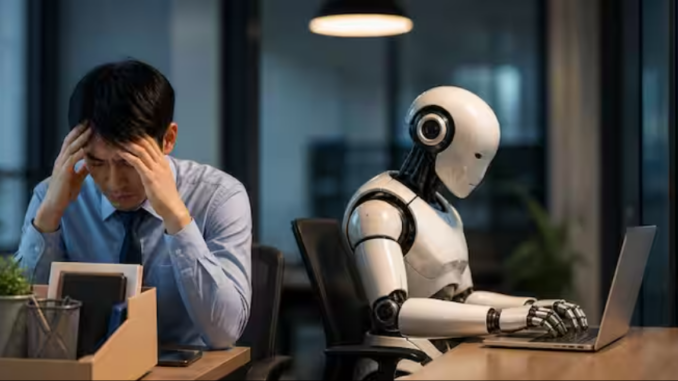
NewDelhi: A court in China has made something very clear — if your company decides to bring in artificial intelligence, that’s their call but the cost of that call cannot be handed to the employees.
This is not a small development. It could change how businesses around the world think about replacing human workers with machines.
Here Is What Happened
A senior tech worker — referred to in court documents by his last name, Zhou — was working at a Chinese technology company. The company brought in a large language model, which is a type of AI tool that can handle writing, research, communication, and many other tasks that people used to do manually.
Once that AI was in place, the company told Zhou his role was no longer the same. They moved him to a lower position and cut his salary. Zhou said no. He refused to accept the demotion. So the company fired him.
Zhou took his case to court.
What the Court Said
The Hangzhou Intermediate People’s Court looked at the situation and came to a clear decision — the company was wrong.
The judges pointed out that under Chinese labor law, a company can only let someone go under specific conditions. For example, if the business is shrinking. Or if the company is in serious financial trouble. Or if something major happens that makes it truly impossible to keep someone on.
Choosing to use AI does not fall into any of those categories.
The Core Argument
The court made a point that is worth thinking about carefully. When a company decides to adopt new technology, that is a business decision. It is something the company chose to do, likely to save money or work faster. That choice might be smart. It might even be necessary. But the worker did not make that choice. The worker did not cause that situation. So why should the worker pay the price for it?
In simple terms — you chose to bring in AI. That is on you, not your employee.
Not the First Time
This is now the second time a Chinese court has ruled this way. Back in December 2025, a labor arbitration case in Beijing reached the same conclusion. A worker argued they were pushed out because AI had taken over their duties, and the decision went in their favor.
Two rulings in less than six months. That is not a coincidence. That is the beginning of a legal direction.
Why This Matters More Than It Seems
What makes this especially significant is where these rulings are coming from. Hangzhou is one of China’s most active technology cities. It is home to Alibaba and many other major tech companies. This is not a court in a place that is unfamiliar with AI or suspicious of it. These are cities that are deeply involved in building and using these tools. And even there, the courts are drawing a line.
The Global Contrast
The rest of the world has not drawn that line yet.
In many countries, being replaced by AI is just something that can happen. There are no specific laws saying a company must keep you on after it automates your job. The general rule in most places is that companies have the right to let people go for business reasons, and switching to AI often qualifies as a business reason.
That gap — between what China is doing and what everyone else is doing — is going to matter more and more as AI tools get better and more affordable.
The Bigger Question
Right now, this is a Chinese legal story. But the question it raises belongs to every country: when a company profits from replacing a person with a machine, does that person have any rights?
China, at least for now, is saying yes.
Leave a Reply