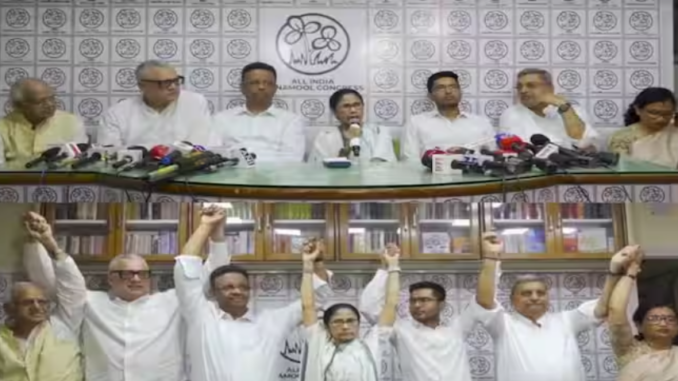
NewDelhi: The result of the West Bengal Assembly elections has dealt a major a major setback for Mamata Banerjee’s Trinamool Congress (TMC). The party, which had secured 215 seats in the previous election, has now slipped below the 100-seat mark. The scale of the loss has led to speculation about its impact beyond the state, especially on Opposition politics at the national level.
Mamata has long been one of the most visible Opposition voices against the Bharatiya Janata Party (BJP)-led Centre. Her political influence was also seen in the way other regional leaders supported her on important issues. Leaders such as Samajwadi Party (SP) chief Akhilesh Yadav and Rashtriya Janata Dal (RJD)’s Tejashwi Yadav had publicly backed her positions on several occasions.
This defeat is not only about one party’s performance in one state. The TMC has been the third-largest Opposition party in Parliament, after the Congress and the SP. In the 2024 Lok Sabha elections, it won 29 out of 42 seats in West Bengal and played a role in the formation of the INDIA bloc against the BJP.
Veteran journalist Rasheed Kidwai says the outcome will have political consequences. “With this win, the BJP will now try to make inroads into all 42 seats in West Bengal. Mamata Banerjee is a big leader and her party’s loss weakens the Opposition. This strengthens the BJP,” he said.
He also pointed to the lack of unity within the Opposition camp, saying, “The Opposition unity is not visible in practice. Different parties follow different ideologies, while the BJP has a clear political base. There is no clear alternative narrative coming together.”
Journalist Neerja Chowdhury too believes that the overall Opposition space has weakened after recent results across states. “The entire Opposition has become weaker. Many senior leaders have lost. One possible outcome is that if Opposition parties try to build pressure on the BJP, they may face political counter-action.”
At the national level, the BJP has expanded its presence across several states in recent years, including Uttar Pradesh, Maharashtra, Madhya Pradesh, Gujarat and others. The victory in a large state like West Bengal adds to the ruling party’s political advantage and further strengthens its position.
Professor DM Diwakar of the AN Sinha Institute of Social Studies, Patna, says the situation is becoming increasingly one-sided. “The BJP prefers politics without a strong Opposition. This victory boosts its confidence. The Opposition now needs to rethink its approach. In parliamentary politics, personal interests dominate, and parties often act individually,” he said.
He added that Opposition fragmentation is an important concern. According to him, regional parties and national Opposition groups are split, and coordination between them is weak. He pointed out that their strategies often exist on paper rather than translating into joint action on the ground.
The West Bengal result also brings attention back to earlier attempts at Opposition coordination. In 2023, several leaders gathered in Patna to discuss a united front ahead of the 2024 Lok Sabha elections. Leaders, including Mallikarjun Kharge, Rahul Gandhi, Sharad Pawar, Akhilesh Yadav, Mamata Banerjee, Arvind Kejriwal and others, attended the meeting. However, internal differences and changing alliances weakened that effort over time.
Experts say the latest outcome has placed the Opposition at a crossroads. While some believe the Congress could take a leading role if other parties come together under its leadership, others argue that fragmentation has made coordinated Opposition politics difficult to sustain.
Kidwai summed up the challenge by saying that while the BJP moves to plan its next steps after each result, Opposition parties lose momentum after setbacks, which affects their ability to build continuity between elections.
Leave a Reply