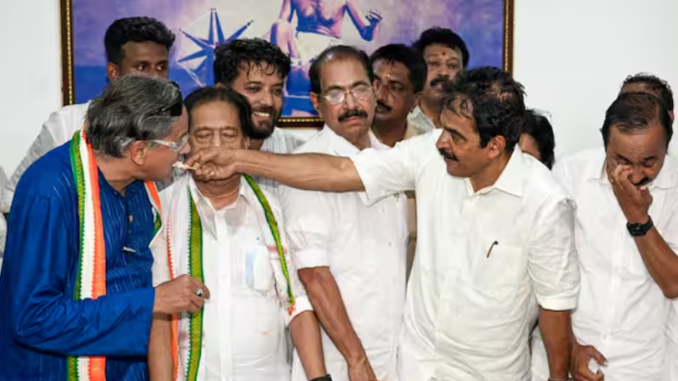
Kerala: Congress party has just received a huge mandate in Kerala assembly elections, managing to oust the Left parties and returning to power in the state. However, the party is still undecided over the Chief Minister’s face, with not only eligible MLAs, but also Congress MPs pushing for the post. This shows a clear infighting within the Congress for a responsible post that should go to an eligible person and not to the power-hungry folks. Interestingly, out of the four main contenders in the race, two are MPs who did not contest the assembly elections. The faces in the race are MLA VD Satheesan, MLA and former Kerala home minister Ramesh Chennithala, MP KC Venugopal and a very less likely consideration, MP Sashi Tharoor. Of these, Venugopal is the close aide of Rahul Gandhi.
The UDF won 102 seats in the 140-member Assembly, ending a decade-long rule of the Left Democratic Front (LDF). Congress emerged as the single-largest party in the alliance with 63 seats, while its ally, the Indian Union Muslim League (IUML), secured 22 seats. Notably, just a day after the election results, Chennithala had openly hinted at his claim to the Chief Minister’s post while posters of Venugopal alongwith Rahul Gandhi is dotting the key spaces in Delhi and Kerala. He also received a grand welcome from his supporters in New Delhi as if he was the main architect of the Congress party’s success. Though the Congress party has appointed two observers – Ajay Maken and Mukul Wasnik – the shadow of the party’s high command still looms large. As the power battle continues in Kerala and lobbying goes unabated with the Congress high command, the party must not forget its lessons from Rajasthan, Madhya Pradesh and Assam.
In Madhya Pradesh, Congress formed a government in 2018 by defeating the BJP. Then, Scindia wanted to lead the party and become Chief Minister but Congress ignored him and went ahead with Rahul Gandhi’s trusted aide Kamal Nath. Result: a rebellion in 2020 and the collapse of the Congress government.
In Rajasthan, the Congress party bagged a clear mandate due to the groundwork of Sachin Pilot, but he was ignored for Ashok Gehlot, again a close confidant of Rahul Gandhi and Sonia Gandhi. The internal discord soon went public and the party lost the next election.
In Assam, Himanta Biswa Sarma was ignored for ageing Tarun Gogoi and today, Congress has been wiped out of the entire northeast.
The Congress often overlooks a crucial electoral reality: internal party popularity does not always translate to public mandate. Voters prioritise leaders who possess genuine grassroots legitimacy and have earned the community’s trust. Historically, when the party fails to synchronise its leadership choices with the aspirations of the modern electorate, the result is typically internal chaos, institutional stagnation, and eventual electoral ruin.
Kerala is currently navigating a similar crossroads. When a specific leader is projected as the face of a campaign, installing a different individual after the win creates a massive gap in representative credibility. Such a move risks alienating dedicated party cadres and shattering the delicate alliance of voter expectations that secured the UDF victory. In a politically sophisticated state like Kerala, where citizens demand transparency and accountability, voters are unlikely to overlook backroom deal-making that ignores their perceived choice.
The party leadership must understand that modern governance cannot be dictated by seniority or internal power-brokering alone. Instead, it must embody the same democratic momentum that fueled its campaign success. The previous collapses in Rajasthan, Assam, and Madhya Pradesh serve as stark warnings; if the Congress ignores these historical lessons, it risks a self-inflicted defeat that the electorate may not easily forgive. The party must promote grassroot leaders who deserve recognition, a culture being created by the BJP.
Leave a Reply