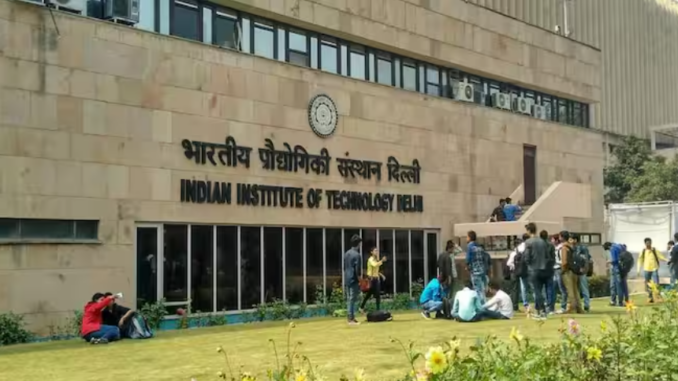
NewDelhi: India’s higher education system is growing, but its funding pattern is raising questions about what it is actually delivering. Every year, lakhs of students enter a long and exhausting race for a limited number of seats in prestigious institutions such as Indian Institutes of Technology (IITs), Indian Institutes of Management (IIMs) and National Institutes of Technology (NITs). Around 23 lakh students appeared for the IIT-JEE last year to compete for 18,191 seats. Similar competition is seen in medical education through the National Eligibility cum Entrance Test (NEET), where demand far exceeds available seats.
Taken together, India’s top institutions offer around 60,000 seats. These institutions serve a small share of students but continue to receive a large portion of public funding. At the same time, most students study in a much wider network of universities and colleges that function with tighter resources.
A system built around peak institutions
India has over 1,300 universities and more than 50,000 colleges, according to official data. Total enrolment stands at 4.46 crore students. Of this, nearly 3.2 crore are in state public universities, which handle the bulk of teaching responsibility across the country.
In comparison, elite institutions such as IITs, IIMs and NITs together serve around 10 lakh students but receive a large share of funding from the higher education budget. These institutions are seen as the country’s international face in education, research and placements.
The latest Union Budget allocation for higher education stands at Rs 55,727.22 crore. A major portion goes to central universities like IITs, IIMs and NITs, while thousands of colleges and state universities share the rest of the resources.
The real pressure point – outcomes
While these top institutions often get the spotlight, the bigger challenge is elsewhere in the system. Reports suggest that nearly 85% of engineering graduates do not secure placements. At the same time, a large share of the workforce is not working in roles that match their skills.
The Economic Survey has also shown that more than 80% of employees are not in jobs matching their training. Only around 56% of the workforce is considered formally skilled, showing a mismatch between education and employment. This points to whether the system is delivering the desired results across the board, not only at the top institutions.
Investment and system capacity
India’s spending on research and development has been around 0.6-0.7% of GDP in recent years. Experts say this level of investment limits how far institutions can go in international research competition.
They say that improving a few institutions will not change India’s position in emerging fields like artificial intelligence (AI) and advanced technology. The system, they explained, needs stronger investment, better institutional structures, deeper collaboration and improved talent development to compete with leading countries.
The experts said government funding is no longer enough, and institutions will depend more on industry partnerships, private money and international collaboration.
Expansion without equal depth
India’s higher education system has grown fast and now includes more than 70,000 institutions across the country. The Gross Enrolment Ratio has improved to above 31%, showing more students are entering higher education than before.
However, growth has not always meant the same level of quality everywhere. Many new institutions have opened, including more IITs, IIMs and AIIMS, but problems of quality teaching, infrastructure and job readiness are still there in many places.
The number of private colleges has witnessed a phenomenal growth across the country, especially along highways and in semi-urban areas, but their quality and outcomes are not the same everywhere. State universities, meanwhile, still depend heavily on government support, which is often limited.
A system searching for balance
The core issue is not only how funding is divided between elite and mass institutions, but how the system performs as a whole. India has built strong “peak institutions” that perform well internationally, but the larger base still struggles with uneven resources and outcomes.
Within IITs themselves, funding differences exist. IIT Bombay receives far more support than newer IITs such as Goa or Mandi. It proves that hierarchy exists even within top institutions.
Experts say the priority should not only be on opening new institutions, but improving what exists across the board.
Leave a Reply