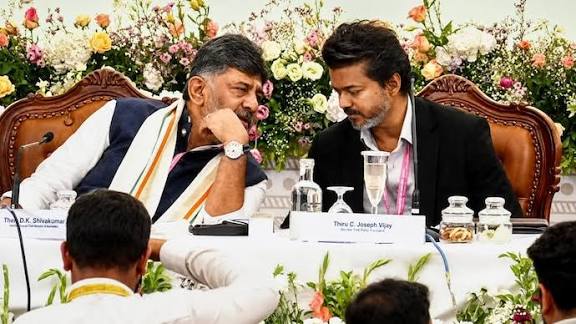
The contentious Mekedatu dam matter is back in the political fold in Tamil Nadu and Karnataka, this time triggering a bitter exchange within the Congress party. Karnataka Chief Minister DK Shivakumar remarked, in the presence of Prime Minister Narendra Modi, that the construction of the Mekedatu dam could be stopped by no one. The remark drew ire from Tamil Nadu, with Congress colleague and TN state president Manickam Tagore condemning the Chief Minister’s stand.
Shivakumar urged the Prime Minister on Friday to expedite the statutory clearances for the reservoir project and sought the withdrawal of the recommendations of the Kasturirangan report. He also asked the Centre to align corporate social responsibility (CSR) initiatives with the state’s guidelines to help upgrade 1,000 government schools into Karnataka Public Schools.
Shivakumar placed these three demands, underscoring the need for cooperation between the Union and state governments to address critical developmental challenges. Referring to the proposed Mekedatu dam, he said the Supreme Court had already delivered its verdict and that the legal position was settled.
“Sir, you just saw the dam on the Cauvery. The Supreme Court has delivered a clear verdict to all of us that Mekedatu has to be built in Karnataka, and no one can stop it. We want you to help us legally,” he said.
Responding to the Chief Minister’s comments, Tamil Nadu Congress chief Manickam Tagore said the project could not proceed without consulting Tamil Nadu and taking its views into consideration.
“Without consulting Tamil Nadu’s views or taking Tamil Nadu’s views, Mekedatu cannot proceed. And we will oppose, continue to oppose. Tamil Nadu is united. We want Bengaluru to have water; there is no question about not having water for Bengaluru. There are forces which are trying to create a divide between Tamil and Kannada people. We are all Indian, we are all united,” Tagore said.
In a strongly worded post on X, Tagore also termed Shivakumar’s remarks “deeply condemnable”, accusing him of adopting a stubborn position that violated the Supreme Court’s ruling and the final award of the Cauvery Water Disputes Tribunal. He said the Karnataka Chief Minister’s demand for final approval from the Centre went against the principle of federalism and threatened the livelihoods of farmers in Tamil Nadu.
MK Stalin Wades In
The controversy also prompted former Tamil Nadu Chief Minister MK Stalin to write to Chief Minister Vijay, urging his government to take immediate action on the Cauvery issue.
In his letter, Stalin slammed Shivakumar’s latest remarks, and said the Cauvery was the lifeline of Tamil Nadu and that the state’s farmers depended on its waters for their livelihood. He accused Karnataka of repeatedly taking unilateral decisions on the river and said Tamil Nadu’s position had consistently been that its water rights would be secured through legal means.
Referring to the proposed engagement between the Tamil Nadu and Karnataka governments after Vijay assumed office, Stalin said he had earlier cautioned against holding bilateral discussions on the Cauvery issue without adequate clarity and transparency.
He recalled that he had previously urged the Tamil Nadu government to convene an all-party meeting to discuss the state’s next course of action on the Mekedatu issue. He also pointed out that the DMK, when it was in the Opposition, had raised the demand for such a meeting in the Tamil Nadu Assembly. With Shivakumar once again asserting Karnataka’s position on the dam, Stalin said the Tamil Nadu government could no longer afford to remain silent.
He urged Vijay to convene an all-party meeting to formulate a united response to the Karnataka Chief Minister’s remarks. Stalin further suggested that the resolutions adopted at the meeting, along with the unanimous resolution passed by the Tamil Nadu Assembly in June opposing the Mekedatu dam, should be presented to the Prime Minister.
Stalin stressed that protecting Tamil Nadu’s Cauvery water rights required political unity, with parties setting aside their differences and individual political preferences.
Bureau Report
Leave a Reply