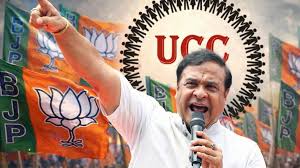
As Assam is gearing up for Assembly elections, scheduled for April 9, 2026, the ruling BJP has placed some key poll promises, including Uniform Civil Code (UCC), laws against “land jihad” and “love jihad”, and aggressive eviction drives against alleged illegal immigrants. The Saffron party framed these as measures to protect the state’s civilisation, heritage and rights” and indigenous identity.
Critics and opposition parties describe the approach as a calculated bid to polarise Hindu and indigenous voters against Bengali-speaking Muslims, often labelled as “Bangladeshi infiltrators” or “Miyas.”
The UCC Promise: Uniformity with Exemptions
On March 31, the BJP released its 31-point “Sankalp Patra” manifesto in Guwahati. It promises to implement the UCC within three months of forming the government, explicitly excluding areas under the Sixth Schedule of the Constitution (which covers tribal autonomous councils) and protecting the rights of tribal and other ethnic communities.
Union Home Minister Amit Shah, addressing a rally in Assam on March 29, said that the UCC would ban polygamy and bring uniformity in civil laws.
CM Himanta Biswa Sarma describes the UCC as a means to counter ‘love jihad’ through new legislation.
According to political observer, in Assam’s context, the UCC is presented not merely as a national ideological commitment but as a safeguard for indigenous customs against practices perceived as threats to demographic balance.
Eviction drives
The Assam government under Sarma has intensified eviction operations against unauthorised settlements on government and forest land. Since 2021, authorities claim to have reclaimed over 1.5 lakh bighas which is approximately 49,500 acres.
If re-elected, the BJP promises to clear another 165,000 acres. Since last year, authorities have also invoked the Immigrants (Expulsion from Assam) Act, 1950 to ‘push back’ hundreds of declared foreigners.
However, Sarma has repeatedly clarified his stance, saying the drives target only illegal Bangladeshi infiltrator, not indigenous Muslims or Assamese settlers.
The government argues these drives as necessary to protect public resources and reverse demographic changes stemming from post-1971 migration, a core issue since the Assam Agitation (1979–1985) and the Assam Accord.
Chief Minister Sarma has also been candid about the electoral logic. In January 2026, he said that “Assam is a polarised society” and that “for the next 30 years, we have to practice the politics of polarisation if we want to live.” He clarified that the divide is not Hindu versus Muslim but “Assamese” versus “Bangladeshi Muslims.” He said we do not fight with Assamese Muslims, we fight with Bangladeshi Muslims.
Assam’s politics have long revolved around migration. The 2019 National Register of Citizens (NRC) excluded nearly 1.9 million people (many Bengali-speaking Muslims), while the CAA fast-tracked citizenship for non-Muslim migrants from neighbouring countries, triggering widespread protests.
Whether this overt focus on polarisation translates into seats will be clear on May 4, 2026. According to several analysts, what is already evident is that, in Assam’s uniquely sensitive demographic landscape, the BJP has chosen to double down on the very issues that have defined its rise in the state since 2016, turning concerns over infiltration and cultural preservation into a direct electoral pitch.
Bureau Report
Leave a Reply