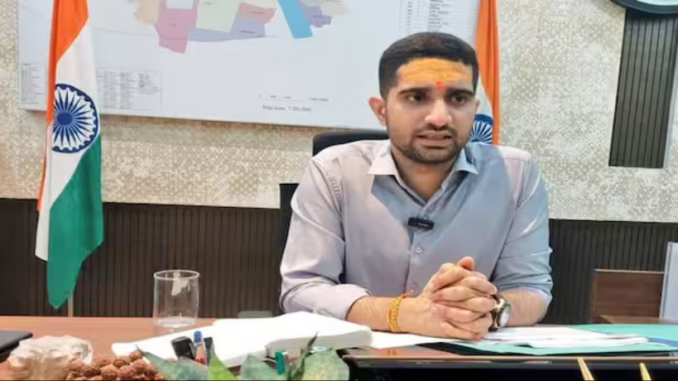
Varanasi: When the holy city of Ganges was dealing with a serious water crisis when IAS officer Himanshu Nagpal took charge as the chief development officer. The situation on the ground pointed to increasing load on groundwater sources. Around 700 borewells were being dug every year as demand from hotels, homes and private companies kept rising.
At the same time, many buildings were not following the rule on rooftop rainwater harvesting, arguing that there was no space for it.
Over time, the impact became visible across the city. In several areas, access to water became difficult. Handpumps started giving inconsistent supply, and ordinary residents were the first to feel the shortage.
When enforcement efforts began, resistance came from parts of the private sector. In the middle of this, a problem caught attention – a college campus that faced heavy waterlogging every monsoon. The problem led to a new idea where rainwater was no longer treated as waste and was instead directed towards recharging groundwater levels.
Instead of pushing companies to install rainwater harvesting systems only on their own properties, a different approach was introduced. They were asked to build these systems on rooftops of public institutions such as schools, colleges and hospitals. The idea was to collect rainwater where it falls in large public spaces and send it back underground in a planned way.
This change led to large-scale results. More than 1,000 public buildings were converted into groundwater recharge systems. Along with this, 393 ponds were constructed across the city to help store and manage water naturally.
The work did not stop there. Around 6,000 handpumps were redesigned so they could help push water back into the ground instead of only extracting it. A 30 km stretch of a polluted river was also revived as part of the larger effort. Slowly, the effect began to show in surrounding areas, with 39 villages regaining access to usable water sources.
The project also saw support from WWF and IIT (BHU), which helped in restoring wetlands using scientific planning and local geography-based methods. These steps worked together to improve groundwater recharge over time.
As the system expanded, changes became visible in water availability. Groundwater levels started to recover, and water began returning to areas that had been struggling for years.
No new technology was introduced in this effort. The approach relied on existing methods, which were used in a different way. The central idea was that rainwater should not be allowed to run off and get wasted when it can be directed back into the ground.
The experience now raises a larger question for many cities facing similar challenges – what if this approach is adopted on a wider scale?
Leave a Reply